Category: Secret Srories

  • FOMO Farming – Why Most Farms Fail Before They Start

    Most farms do not start because a farmer saw a problem in the market. They start because a farmer saw his neighbour with a farm.

    That is FOMO — Fear Of Missing Out.

    And it is quietly killing farms before they even have a chance.

    The Story Of John And James

    John and James were neighbours. Good neighbours. They did not talk every day, but they had never fought about anything either.

    One Monday morning, John came home from work and noticed something strange. A group of contractors were busy in James’ backyard, building something big.

    He wanted to ask James about it. But they had not spoken in over a week. It felt too intrusive to just walk over and ask.

    So John waited.

    Two weeks later, the structure was complete. It was a chicken house.

    “Interesting”, John thought. “Let me see if he will make any money from this.”

    James Starts To Grow

    James brought in his first batch of chicks. Within three months, he was supplying chicken meat to the local market.

    One afternoon, James knocked on John’s door and asked if he needed chicken meat. Out of friendship — and because he genuinely needed them — John said yes. He became one of James’s regular customers.

    Weeks passed. James kept stocking new batches. His customer base grew steadily. People in the neighbourhood started calling him ‘The chicken guy’.

    John watched all of this quietly. Inside, he felt uneasy.
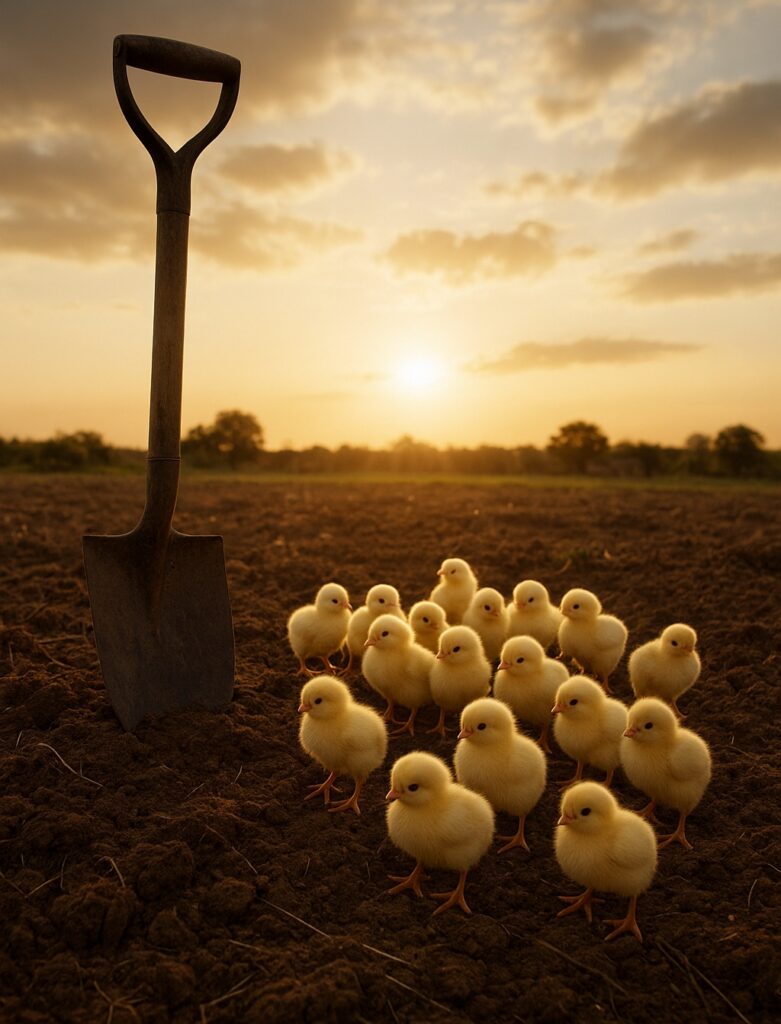
    Yellow day old layer chicks.Definitely still in brooding out on the farm with a spade - a commonly used farm tool/equipment

    The Decision That Changed Everything

    John talked to his wife about it. They both agreed — James must be making serious money. Why else would people keep coming back? Why else would he keep expanding?

    So they made a decision.

    Husband and wife visited the hatchery in the nearby town. They ordered chicks and started building their own chicken house. They did not ask James for advice. That would have felt like trespassing on his business territory.

    Three months later, their first batch matured. They started selling meat, just like James.

    It was hard at first. But slowly, people started buying from them too. Some of James’s loyal customers even switched over. Business felt good.

    When The Numbers Tell The Truth

    At the end of the batch cycle, John and his wife sat down to count their money.

    Something was off.

    They called John’s sister, who worked as an accountant, to help them go through the numbers. She looked at the records carefully and then looked up at them.

    “You have been making losses,” she said. “Your expenses are 15% higher than your revenues. Every month, you are losing money.”

    John was heartbroken.

    But then he asked the question he should have asked from the very beginning.

    What about James? Is poultry farming profitable for him too?

    The Truth About James

    John finally walked over to James’s house and asked him directly. “How is the business really doing? Is poultry farming profitable on your end?”

    James told him the truth.

    The business was not profitable. James had one large hotel outside town that bought most of his eggs and meat in bulk. Whatever was left, he sold to neighbours and the village market. Even with all that, he was only breaking even.

    He could not shut the farm down either. He had taken out a loan to start it. Every month, he farmed just to repay that loan.

    It was a cycle. A vicious one. Farm. Break even. Repay loan. Repeat.

    Not all that glitters is gold.

    Why FOMO Farming Almost Always Fails

    What you just read is not a unique story. It happens every single day across farms big and small.

    People start farming not because they identified a market gap, did a feasibility study, or had a clear business plan. They start farming because someone they know appears to be making money.

    A neighbour. A friend. A random farmer on social media posting about profits every week.

    These people sell a dream. And the dream looks real because you can see the chicken house, the chicks, the customers coming and going. What you cannot see is the loan, the losses, the breaking even, the quiet stress behind the scenes.

    Studies show that up to 70% of agricultural businesses fail in their first three years. Many of those failures trace back to one simple problem — the farmer started for the wrong reason.

    FOMO is a wrong reason.

    What FOMO Does To Your Thinking

    When you see someone else farming and apparently making money, your brain starts running a story.

    He must be making so much money.

    His life must be so much easier now.

    If I start now, I will make that money too.

    If I wait, I will miss this opportunity.

    That last thought is the dangerous one. You feel like the window is closing. Like you have to act right now or you will lose out forever.

    But that is rarely true.

    A farming opportunity that is real today will still be real in six months — after you have done proper research.

    After you have spoken to actual farmers who show you real numbers.

    After you have asked the hard question: Is poultry farming profitable in my specific market, at my specific scale, with my specific resources?

    The Right Way To Start A Farm

    Before you place a single chick order, here are some recommendations you should do.


    1. Talk to a real farmer — and ask for the numbers.
    Not the polished version. The real numbers. Revenue, expenses, loan repayments, labour costs, losses from sick birds, market price fluctuations.

    If a farmer is not willing to show you that, their “success” story is not useful to you.


    2. Study your local market first.

    Who will buy your eggs or meat?

    How many other farmers are already supplying that same market?

    Is the market growing or shrinking?

    Can it absorb one more supplier without everyone’s prices dropping?


    3. Run a simple feasibility test.
    Before spending a single shilling on construction, write down your projected costs and your realistic revenue. Not best-case revenue — realistic revenue.

    If the numbers do not work on paper, they will not work in real life.


    4. Start small and learn.
    A 50-bird first batch teaches you more than any YouTube video. Starting small keeps your losses manageable while you figure out the market, the feeding, the disease management, and the sales cycle.


    5. Have a clear customer before you start.
    James had one hotel that bought in bulk. That one customer kept him alive — even if just barely.

    Before you build a chicken house, find one person or business willing to commit to buying from you consistently.

    There Is Always Another Bus Coming

    There is a famous saying in investing: ‘There is always another bus coming’.

    It means this — missing one opportunity does not mean you have missed everything. Another one is always on its way. The farmer who waits, researches, and starts with a clear plan will almost always outlast the farmer who jumped in because of FOMO.

    So resist the urge. Control the impulse. Do not start a farm just because your neighbour has one and appears to be winning.

    Ask the harder question first: Is poultry farming profitable for me, in my situation, right now?

    If the honest answer is yes — go for it with everything you have.

    If the answer is unclear — do more research before you spend a single coin.

    The Bottom Line


    John lost money. James was trapped in a loan cycle. Neither of them started with a real plan.

    Both of them started because of how things looked from the outside.

    Farming is a real business. It rewards preparation, market knowledge, and patience. It punishes impulse, emotion, and FOMO.

    Before you order those chicks, before you break ground on that chicken house — make sure you are starting for the right reasons.

    Your farm deserves better than FOMO.


    Thinking about starting a layer poultry farm?

    Download my Free Guide and make sure you start your farm the right way.
    Free beginners guide to starting a profitable layer poultry farm. Step by Step guide.
    Name
    Limited access. Join other serious farmers who have taken the guide and get support.


    See you next Friday!

  • The Bucket Vs Pipeline Mindset Everybody Should Know About

    Are You Carrying Buckets or Building a Pipeline?


    Once upon a time, there was a small village.
    It was a good place to live.
    But there was one big problem.
    There was no water unless it rained.


    So the village elders made a decision.
    They asked people to apply for a contract to supply water daily.
    Two men were chosen: Ed and Bill.
    The elders wanted competition.
    They believed it would keep prices low and ensure steady supply.

    Ed

    Ed started immediately.
    He bought two metal buckets.
    Then he began walking to a lake one mile away.
    Every day.
    Morning to evening.

    He filled the buckets and carried water back to the village tank.
    It was hard work.
    But he was happy.
    He was making money.
    And he had a secure contract.


    Every morning, he woke up early.
    He made sure the village had water before people woke up.
    He worked every single day.

    Bill

    Bill disappeared.
    For months, nobody saw him.
    Ed was happy.
    He thought he had no competition.
    But Bill was not resting.
    He was planning.


    Instead of carrying buckets, Bill did something different.
    He wrote a plan.
    He created a company.
    He found investors.
    He hired people to help him.

    Then he came back with a construction team.
    Within one year, they built a pipeline from the lake to the village.

    The New Beginning

    At the launch, Bill made some announcements:
    His water was cleaner
    His supply was 24/7
    His price was 75% cheaper

    The villagers were excited.
    They rushed to his tap.

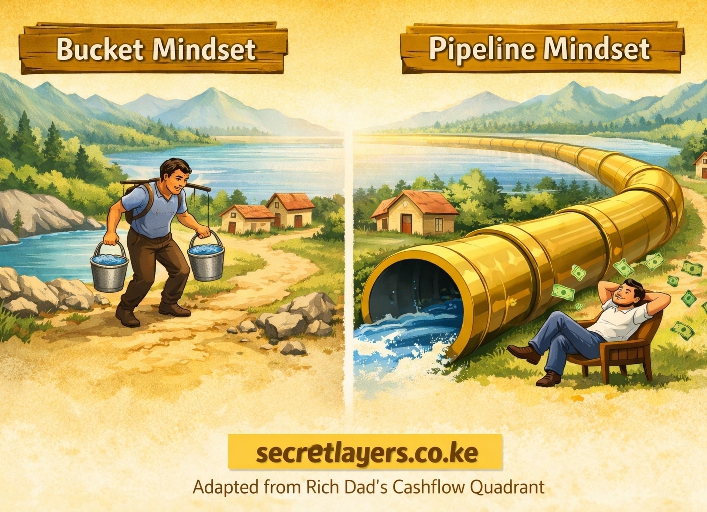
    The bucket vs pipeline mindset.Adapetwd from rich dad's cashflow quadrant to teach hard work vs smart work.
    A visual illustration of the bucket vs pipeline mindset. Which one are you working with?

    The Mistake

    Ed reacted fast.
    He reduced his price.
    He bought more buckets.
    He worked even harder.

    He hired his sons and other villagers to help him.
    Now they worked day and night. When his boys went off to college he said to them, ‘Hurry back because some day this business will belong to you.’

    But maybe there was a problem.When his son’s left for college, they never came back.


    Later on, he faced worker issues. Complains of having to carry one bucket per trip instead of two.
    Costs increased rapidly.
    Work became harder.

    Plan Number 2

    On the other hand, Bill did not stop there.
    He thought bigger.
    “If one village needs water, others do too.”
    So he expanded his system.
    He built pipelines to many villages.


    Now, he only made a small profit per bucket.
    But he delivered millions of buckets daily.
    Even when he slept, people consumed water and money kept coming in.

    Let’s Compare The Two

    Ed worked hard his whole life.
    Bill built a system that worked for him.

    Ask Yourself..

    Are you carrying buckets?
    Or are you building pipelines?


    Are you working hard?
    Or are you working smart?

    Now Back To Farming

    In farming, this is very important.
    You can:
    Sell eggs , milk, meat or vegetables daily and struggle
    OR
    Build a system that scales (distribution, contracts, automation)
    One is hard work.
    The other builds freedom.


    If you want real success:
    Stop thinking like Ed.
    Start building like Bill.

    This story is adapted from the book Cashflow Quadrant by Robert Kiyosaki.

    If you want to learn how you can start and run a profitable layer poultry farm(Like Bill) get this Free Layer Poultry Farming Guide.

    Name
    Limited access. Join other serious farmers who have taken the guide and get support.

    See you next Friday!

  • The Story Of Buddha And The Second Arrow


    Once, Buddha was trying to teach his students a lesson.

    So, he sat them under a tree and asked them a question.

    “If I shoot you with an arrow, would it hurt?

    “Yes,” the students said in unison.


    Then, he asked another question.


    “If I shoot you again with a second arrow at the same spot, would it hurt?”

    This time, the students looked shocked.

    “Of course it would,” they replied.

    A Buddha holding an arrow about to shoot. Buddha means enlightened one and this is used in a Secret Layers story to educate farmers.


    At this point, Buddha cleared his throat and continued.


    “In life, we are usually hit with two arrows.”


    First, there is the arrow of life.
    This includes suffering, loss, disease, and disappointment.
    All these things are painful.
    However, most of them are not under our control.


    Then comes the second arrow.
    This is how we respond to the first one
    .
    For example, it is the self-criticism, the overthinking, and the doubt.

    In addition, it is the constant questioning and denial.

    As a result, this second arrow becomes even more painful.

    But here is the most important part.
    The second arrow is totally under your control.


    Therefore, how you react to problems determines your level of suffering.
    As it is often said, pain is inevitable, but suffering is optional.

    Now, What Does This Have To Do With Farming?

    I believe you cannot become a successful farmer before you master yourself.

    You see, life as a farmer will hit you from all sides.

    Anything that can go wrong on your farm will go wrong.

    At the same time, life will also keep happening.

    You will get sick.
    Your family and friends will get sick.
    You might lose your job.
    You will even get into disagreements.


    So, what really matters is not whether these things happen.

    Instead, it is how you respond to them.
    Spending all your time focusing on problems will not help you.


    However, acknowledging what happened and focusing on solutions will.


    That is what separates you from other farmers.


    In fact, as Alex Hormozi and Leila Hormozi often say:
    “F**k your mood. Follow the plan.”

    That is the mindset you need to have.


    By the way, if you have been struggling with early chick deaths within the first one month, I created something for you.

    Get this Free Brooding Guide, and I will also send you a bonus Layer Poultry Farming Guide.

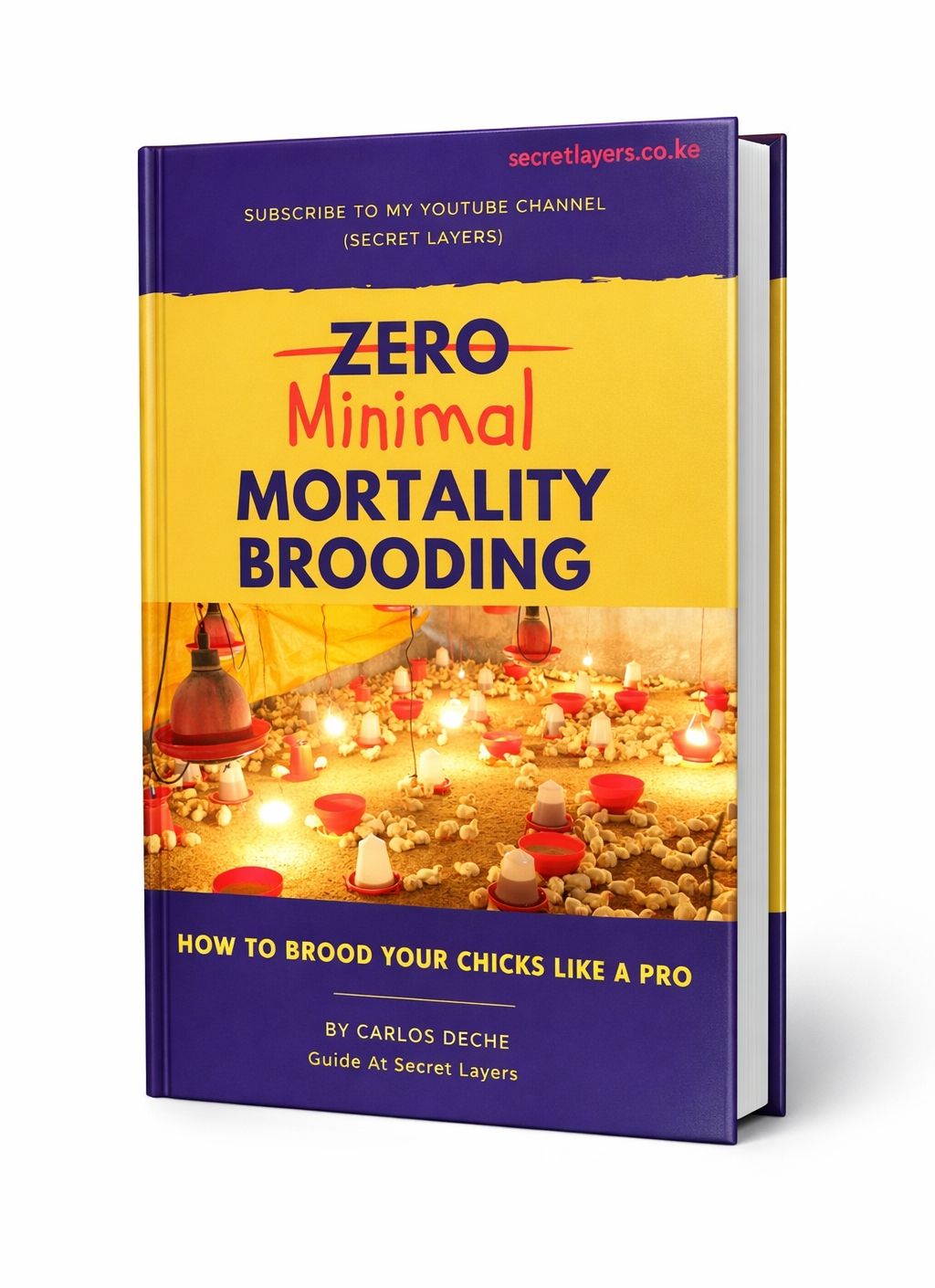
    Free Brooding Guide For Poultry Farmers. Zero (Minimal) Mortality Brooding. How To Brood Your Chicks Like A Pro. By Carlos Deche Guide At Secret Layers
    Name
    Limited access. Join other serious farmers who have taken the guide and get support.


    See you on Friday!


    carlosdeche4040@gmail.com
    secretlayerske@gmail.com

  • The Samurai Master And The Young Warrior

    Once, there was an old samurai master.

    He had trained for many years. Because of that, people knew him as wise, brave, and full of experience.


    Many young warriors wanted to learn from him. However, it was very hard to become his student. In fact, it was almost impossible.


    One day, he was choosing new students. At that time, a young man who had dreamed of becoming a samurai master all his life stepped forward.


    Master,” he asked, “how long will it take for me to become a master?

    Young warrior in training to become a Samurai. In line with a Zen parable perfect for farmers.
    A young warrior training to be a Samurai master.


    The old master replied, “Ten years.”


    The young man was shocked. So he quickly said, “Ten years is too long! What if I train twice as hard? What if I train day and night? How long will it take then?


    The master looked at him and smiled gently. Then he said, “In that case, it will take twenty years.”


    The young warrior was confused. Therefore, he asked, “Why twenty years?”


    Calmly, the master answered,
    “Because if you have one eye fixed on the destination, you only have one eye left to find your way.”

    What Is The Lesson?

    The lesson is simple.


    To achieve true mastery, you must let go of the goal and embrace the process.


    In other words, do not rush. Instead, focus on learning step by step.

    What This Means For Your Farm..

    This lesson also applies to farming.


    Many people think only about money. Others think about owning large land or having a big herd. However, that is not where mastery begins.


    First, think about planning.
    Next, focus on daily management.
    After that, solve problems as they come.
    Finally, always look for new opportunities.


    Success on the farm does not start with profit. Rather, it starts with good systems and patience.


    So stop thinking only about the money, the land, or the herd. Instead, think about the process every single day.


    That is how true mastery is built.

    In line with that..if you’re planning to start layer poultry farming,

    Get this Free Layer Poultry Farming Guide straight to your inbox.

    Free beginners guide to starting a profitable layer poultry farm. Step by Step guide.
    Name
    Limited access. Join other serious farmers who have taken the guide and get support.

    See you next Friday!

    carlosdeche4040@gmail.com

    secretlayerske@gmail.com

  • The Story Of The Chinese Farmer And The Horse


    This is a parable from ancient China that teaches us that things are neither good nor bad. They just are.

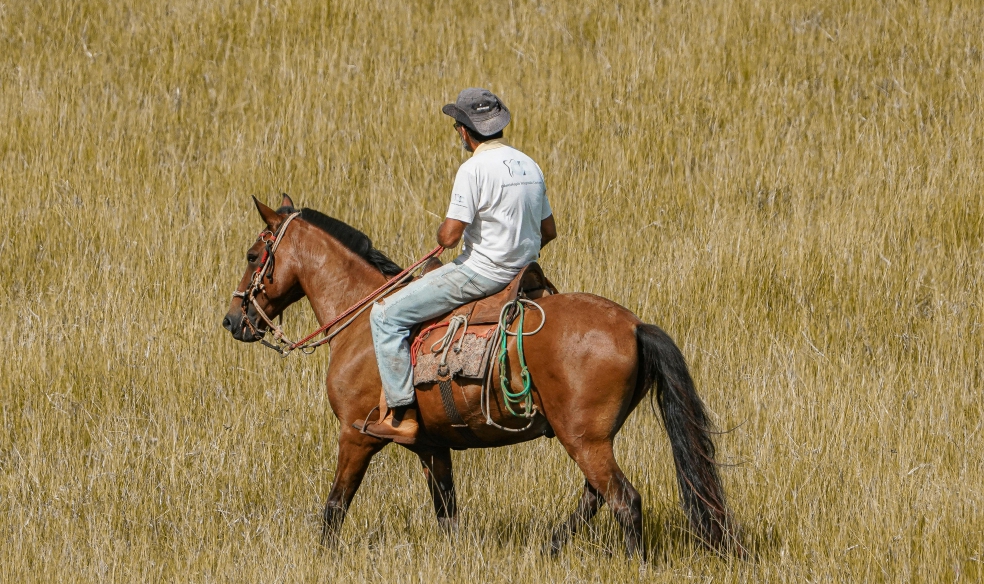
    A farmer on a horse
    An image illustration of the Chinese farmer’s eldest boy on a horse


    A farmer in a rural Chinese village bought a horse and brought it home.
    Early the next morning, as he was feeding the horse, it ran away. His neighbors felt sorry for him. They gathered around his farm and said, “We’re so sorry. How unlucky.”

    The farmer calmly replied, “We’ll see.”


    Just before sunset the next day, the horse returned with seven wild horses. The farmer and his family were very happy. The neighbors came back, smiling. “Oh, you’re so lucky! You now have eight horses. Your farm will grow quickly.”

    The farmer replied, “We’ll see.”


    Three days later, the farmer’s eldest son tried to ride one of the wild horses. He couldn’t control it, and the horse threw him over. The boy fell on the rocks and broke his leg. The neighbors said, “You’re so unlucky. The horses weren’t blessings at all. Poor boy. Poor family.”

    The farmer simply said, “We’ll see.”


    The following day, war broke out in the country. The king’s officers came to recruit young men for the army. The farmer’s son was rejected because of his injury. All the neighbors ran to him, saying, “Oh my God! Your son was spared. That’s so fortunate. How lucky!”

    The farmer replied, “We’ll see.”


    Life events are not inherently good or bad. They just happen. Many times, we try to assign meaning to them. We label events as good or bad. In reality, they don’t make sense in isolation.

    Only after time passes, when you look at the bigger picture, does their meaning become clear.

    Why Did I Write This Story On A Layer Poultry Farming Blog?

    Things will happen in your life and on your farm. More than anything, you need a strong mind to get through these situations, whether they seem good or bad.


    You’ll have good seasons, high production, and strong prices. Other times, you may face disease outbreaks, feed price hikes, personal emergencies, or very poor production.

    That doesn’t mean you try to assign meaning to each situation. Instead, focus on solving the problem at hand or enjoying the success at hand.

    That’s all that matters.


    To learn more about resilience in farming, you need to know about DR.STARR a successful layer poultry farmer.

    Get this Free Layer Poultry Farming Guide to learn how to start and run your layer poultry farm profitably.

    Free beginners guide to starting a profitable layer poultry farm. Step by step guide.
    Name
    Limited access. Join other serious farmers who have taken the guide and get support.

    See you next Friday!

    carlosdeche4040@gmail.com

    secretlayerske@gmail.com

  • The Farmer And The Goose That Laid Golden Eggs

    This is an old story about a poor farmer.

    One morning, as he went to check on his goose, he noticed something unusual sitting in the nest — a bright, heavy, golden egg.
    At first, he doubted it. He thought it was some trick. He almost tossed it aside.
    But something held him back.
    He took it for evaluation, and to his shock, the egg was pure gold.

    The goose that laid golden eggs.
    The farmer and the goose that laid golden eggs.


    The next morning, the same thing happened.
    And the next.
    Day after day, the goose produced a golden egg.
    Slowly, the farmer’s life changed. His poverty faded. His confidence grew. His small farm started to feel like a miracle.


    But as his wealth increased, so did his impatience.
    He grew tired of waiting for one egg each day.
    He wanted all the gold immediately.
    So he made a dangerous decision: he slaughtered the goose, hoping to find a pile of golden eggs inside.


    When he opened it, the truth hit him.
    There were no golden eggs inside.
    And there was no goose anymore.
    He had destroyed the very source of his success.

    In Stephen Covey’s book : The 7 Habits Of Highly Effective People, this is what he says…


    Within this parable is a natural law — the real definition of effectiveness. (Which in the farmers context I’ll say profitability)

    Many farmers think profitability means producing more. More output. More results. More action.


    But the story shows a deeper truth: profitability is always a balance between what you produce (the eggs) and the capacity or asset that produces it (the goose).

    If you chase results and ignore the source, you lose everything.


    If you only protect the source and forget the goal, you will starve.


    True success comes from managing both — production and production capacity — at the same time.

    Let me know in the comments how you are managing production and production capacity on your farm.

    See you next Friday!

    carlosdeche4040@gmail.com

    secretlayerske@gmail.com

  • Ask A Broiler Farmer, Then Ask A Layer Farmer

    Some lessons hit you in ways you never forget—this one came from chickens.


    When I was growing up, I spent a lot of time around poultry farms. One morning, my dad decided to take us to see how different types of chicken farms operate.

    We arrived at the broiler farm just as the sun was rising. The air was thick with the smell of feed and the soft hum of ventilation fans. Workers moved quickly, carrying the chickens from their pens toward the processing area. The birds scattered and squawked, jostling against one another. You could almost feel their fear—they knew what was coming. My dad led us aside before we saw anything more, but the lesson was already clear: these birds were being raised for a single, final payoff. Everything on the farm was geared toward one moment—the sale.


    A few days later, my dad took us to a layer farm. The difference hit me immediately. The hens moved calmly, pecking at the feed, scratching the ground, and laying eggs day after day. The barn was quieter, the atmosphere almost peaceful. The farmer collected the eggs as they came, creating a steady, predictable flow of income. Unlike the broiler farm, success here didn’t depend on selling the birds—it depended on the output they produced consistently.

    Many layer chicken kept for eggs in a big poultry house.
    Layer Chicken in a poultry house.


    My dad stopped and looked at me. “See the difference?” he asked. Both farms own valuable assets—the chickens—but they treat them in completely different ways.

    The broiler farmer is like an investor chasing capital gains: the money comes only at the end, when the asset is sold.

    The layer farmer is like an investor chasing cash flow: the asset produces money day after day, steadily and reliably.

    Most people invest like broiler farmers—they wait for a single big payout and call it risky. The wiser approach is to think like the layer farmer and be the layer farmer: focus on cash flow, let your assets work for you every day, and build wealth steadily.

    The secret isn’t in waiting for the sale—it’s in learning to milk what you already have.

    This is a fictional story inspired by the story of the cattle rancher and dairy farmer in Robert Kiyosaki’s book : Who Took My Money? Why Slow Investors Lose And Fast Money Wins.

    See you next Friday!

    carlosdeche4040@gmail.com

    secretlayerske@gmail.com

  • The Story Of The 3 Bricklayers- Finding Purpose On Your Layer Chicken Farm

    (St.Paul’s Cathedral,London)

    After the great fire of 1666 that destroyed London, the world’s famous architect, Christopher Wren, was asked to rebuild St Paul’s Cathedral.

    ‎One day in 1671, he observed three bricklayers at the project site.

    ‎To the first bricklayer, who was bent over Christopher asked,

    ‎“What are you doing?”

    ‎He replied,

    “I’m a bricklayer. I’m working hard laying bricks to feed my family.”

    This bricklayer looked tired and was way behind in his work.

    ‎The second bricklayer,who was half standing responded,

    “I’m a builder. I’m building a wall.This wall will be a foundation for this building and will protect everyone who will be inside

    ‎ But…

    The third brick layer, who was standing tall when asked “What are you doing?”replied with a smile and said

    “I’m a cathedral builder. I’m building a great cathedral to The Almighty.

    Where people can gather together,pray and celebrate the LORD.

    He was the most productive of the three.

    What has this got to do with Layers Farming?

    3 Lessons
    ‎1. Big Picture Thinking
    ‎ Have the ability to see the end result of what you are doing and how your work contributes to it.

    Look beyond the daily chores.


    Instead of just feeding hens and collecting eggs, envision how your layers farm helps solve the chronic problem of malnutrition in Africa—from families and school children to local restaurants.

    ‎2.Attitude
    ‎Having a positive attitude and pride in what you’re doing will show up in your work and your motivation.

    ‎That belief and pride in your layers chicken farm will definitely show in how you handle your suppliers,customers and even chicken!

    This will provide more motivation to keep you in the game long enough to be successful.

    ‎3.The power of purpose
    ‎The cathedral builder shows a personal expression of purpose that gives higher meaning to his work.

    You’re not just selling eggs—you’re feeding families, empowering small-scale farmers, and improving food systems.


    ‎At Secret Layers our purpose is not to give you information about layers poultry farming – it’s about fulfilling dreams.

    Your dreams.

    ‎This is what our Mission reads..

    To help you go from layer poultry dream to a money-making layer farm.

    ‎And by doing that we are contributing to you, our readers mission.

    ‎That’s the kind of mission I want you to have on your layers farm.

    TIP
    Use our 3-Why Exercise—three simple questions—to uncover your real purpose before you begin your farm.

    Ready to apply these lessons?

    Enter your details to grab a copy of my Free guide and regular Layer Chicken Digest tips via email:

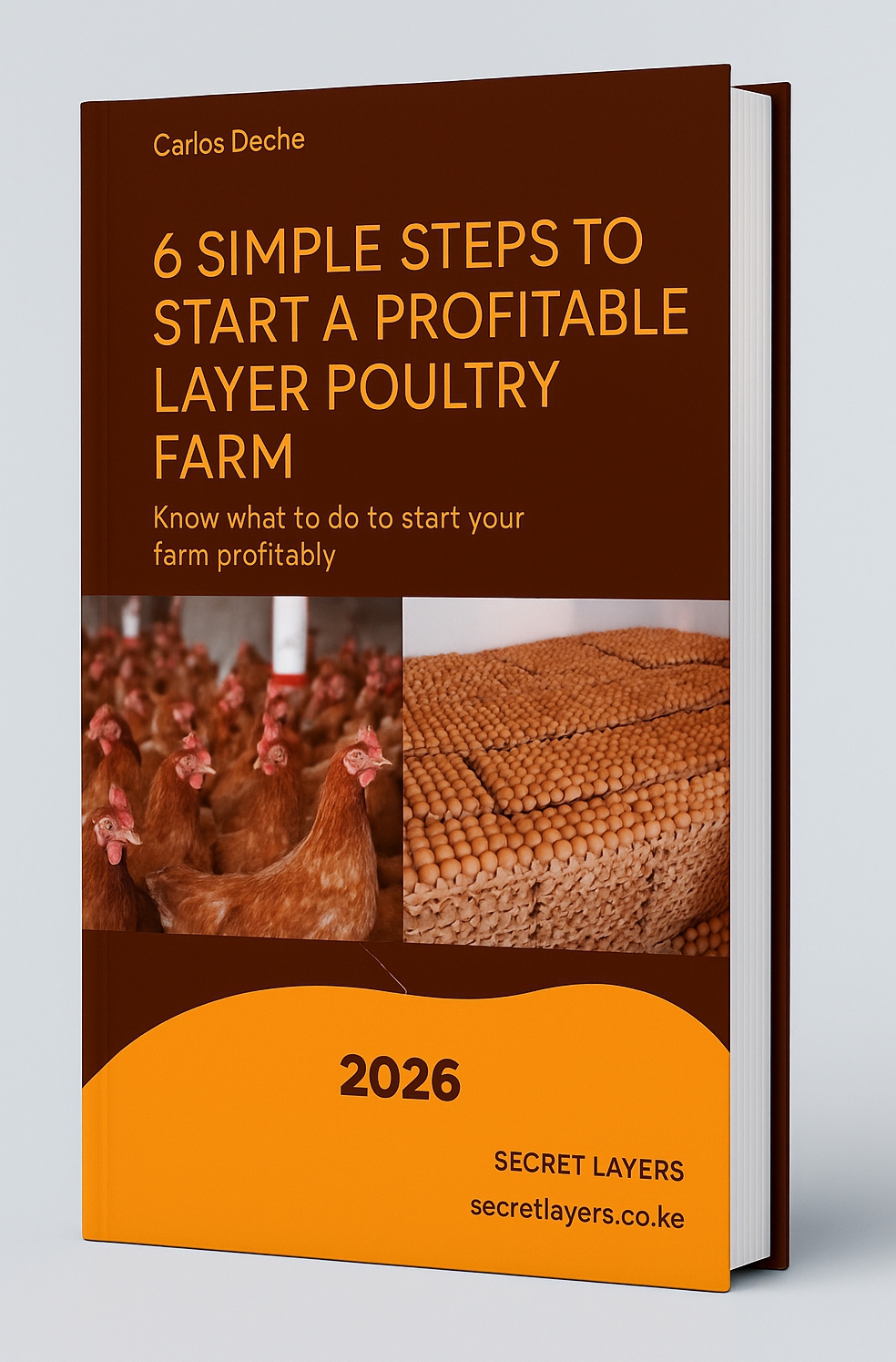
    “6 SIMPLE STEPS TO START A PROFITABLE LAYER POULTRY FARM”

    Free beginners guide to starting a profitable layer poultry farm. Step by step guide.

    Want to Learn More?
    Check out the story behind Secret Layers and how we found our real purpose:

    https://secretlayers.co.ke/blog/start-hereyour-journey-to-profitable-layer-poultry-farming/   

    See you next Friday!

    carlosdeche4040@gmail.com

    secretlayerske@gmail.com