Category: Guides

  • 7 Proven Ways To Protect Your Farm And Save Millions(#7 Is Pure Gold)

    For what worth is your farm if you can’t protect it?

    Why would you go through the struggle of building a farm yet provide no protection to your asset?

    It’s like working hard to become a billionaire and never protecting your wealth, only for it to be stolen by thieves, greedy lawyers, and divorced wives.

    Farm security is one of the less talked about aspects of running a farm. Maybe because it doesn’t directly translate to money in the owner’s pocket. Let me change that today.

    The first rule of creating wealth is to never lose money. And the second? Refer to rule number one.

    Even Warren Buffett himself — the greatest investor to ever live (2026) — says that as an investor, you first have to control your downside before maximizing your upside.

    Imagine if a burglary happens on your farm and everything gets stolen or destroyed. What will you have lost? Not just the animals and property on the farm, but also future income.

    It might be hard to see, but doing just small things to make sure your farm is safe can translate to saving you millions in prevented thefts.

    Now, your farm needs protection against 2 things. One is animals. The second is people. And under people, we have thieves and employees.

    Of the three, employees are the most common, the most expensive, and cause the most damage — but sadly, they are the ones farmers consider least. Most people only think of wild animals and night thieves. The worst thieves on a farm are the ones who steal during the day: your employees.

    In this post, I’m going to give you the 7 ways in which you can ensure tight security on your farm.

    You are working too hard for somebody to just steal your wealth.

    1. Fence Your Farm And Put A Gate

    The first thing is to have a physical barrier around your farm. This will help reduce trespassing, and having one entry point which is gated will allow you to control who comes in and gets out.

    It works for people and animals as well — both wild and domestic.

    The fence should offer real protection. Not some random poles or something somebody can jump over easily. Also make sure you maintain it. Thieves only need a small break to get in.

    2. Security Guard And Employees

    As part of your farm team, a security guard should be one of your employees.

    This is not a must, especially if your farm is small. But if you have a big farm that requires surveillance, then a well-paid security guard will do the job.

    Just make sure he is a trusted person, because security guards are usually the master planners of farm heists.

    Now, I have talked a lot of bad about employees — but that is not how they always are. Not all of them. Most employees are loyal, faithful, and good business partners.

    Train them, respect them, empower them, pay them well, and they will be your security without you paying for it directly or any extra.

    Great employees are the best thing a farm owner can have. Work with them.

    On the other hand, if you get a stealing worker, they will kill your farm. Do you know the saying: hire slow, fire fast? This is where you fire fast. In fact, immediately.

    3. Security Animals

    Farm security is mostly about protection against animals. But some animals can protect against other animals.

    What better way to catch a thief than to use a thief? Same case here — use an animal to catch an animal.

    The beauty of animals is that they also protect against people. These include:

    Cats – which protect against rodents and snakes.

    Dogs – man’s best friend – who protect against thieves. You get a pet and a protector. That’s why I like dogs.

    Any other animal – I recall sharing this on the Secret Layers Facebook page and it was hilarious.

    If you love crocodiles, use them. If you have a tiger, use it. It’s your farm and you can do whatever you want — just make sure you are licensed to keep these animals and that they don’t pose a danger to other people.

    I wonder which thief will go and steal from a farm with crocodiles or a tiger. A real thief!
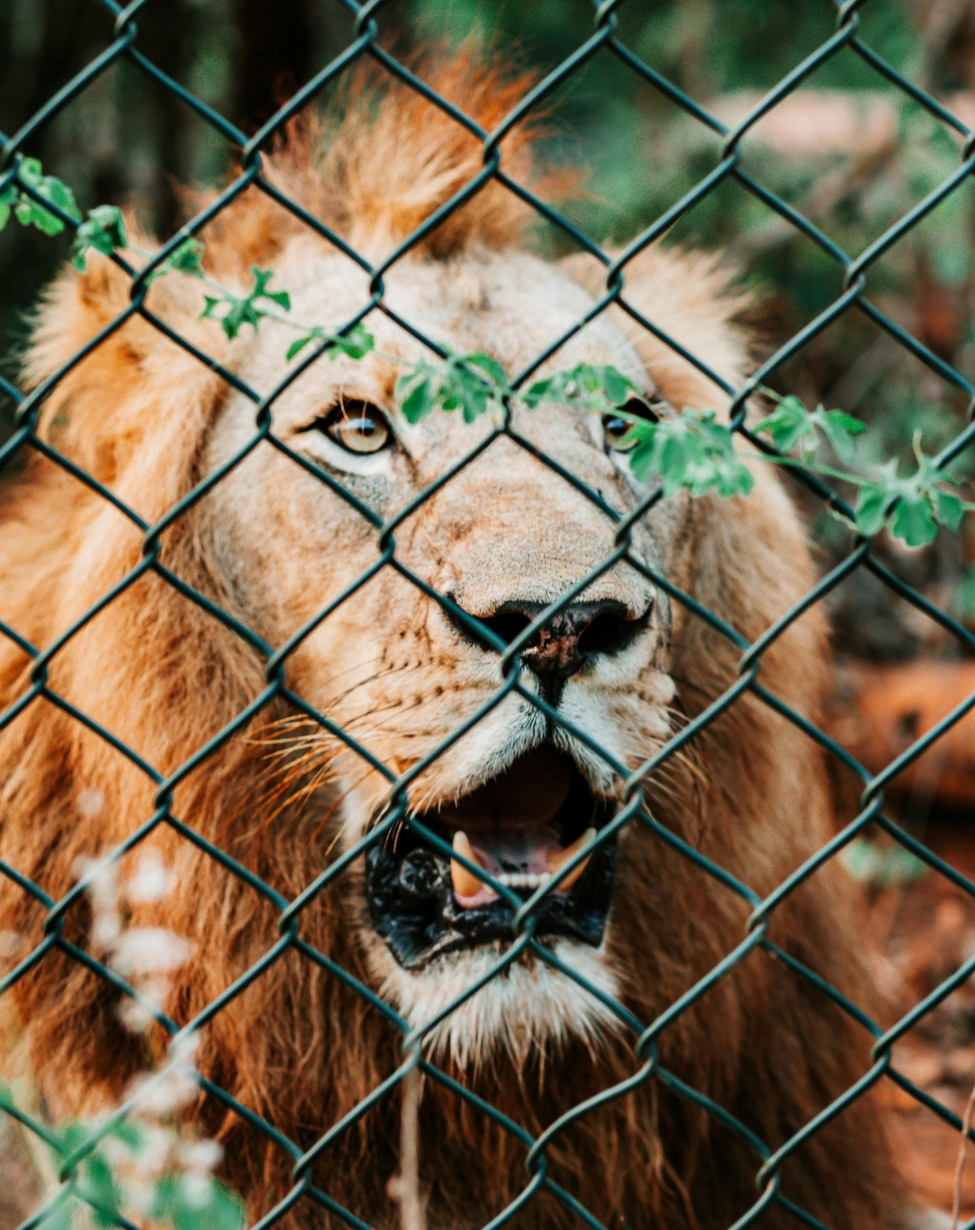
    A roaring lion in a fenced area
    Even if you have access to a lion, use it. After all, it’s your farm.
    (Make sure you comply with the relevant regulations)

    4. Install Security Lights On Your Farm

    Security lights are one cheap and efficient way to keep intruders away.

    Install them at strategic points around your farm and make sure they are bright enough to scare off thieves.

    They also give you peace of mind knowing that your farm is well lit and safe.

    5. Use Surveillance Cameras

    If you have a small farm with the chicken house or cow shed close to your house, you probably don’t need cameras all over.

    But if you have even a single employee, I strongly suggest getting at least one surveillance camera placed strategically in your chicken house and in your feed store.

    These are the two most common places where employees can access and steal from the farm. Monitor these at your own frequency, but make sure your employees know they are being watched.

    Also understand that with time, they will learn how to avoid the cameras and devise tactics to not get caught.

    Stay on the lookout.

    6. Maintain A Good Relationship With Your Neighbours

    Start and maintain a good relationship with your neighbours.

    This is one of the most valuable forms of farm security you can have.

    Talk to them, engage with them, and they will automatically provide you with free security for years and years.

    They will warn you of any danger and be there to help when things go wrong.

    Neighbours are particularly useful when it comes to employee theft, because neighbours are often the customers of stolen farm products. But that’s only if you treat them well.

    Otherwise, they help milk your farm dry through the cheap products they get from your disloyal employees.

    7. Personal Competence

    I put this last, but it is the most important.

    The best and most reliable farm security is you. Yes, you.

    Know what is going on on your farm — everything. Know the standard operating procedures. Know how to raise whatever it is you are farming. Know the prices of inputs and outputs on your farm. After all, it is your business.

    When you know all this, nobody will dare steal from you. And if they do, you will know immediately.

    That makes it easy to catch the thief, fire them, and hire another person. The rest will have a story to tell about how you have zero tolerance for theft.


    These are the 7 ways you can protect your farm from leeches who want to reap where they did not sow.

    If there is one thing I would put more emphasis on, it is Point 7 — your personal competence.

    With that, no manager, no accountant, no worker will ever be able to steal from you and get away with it.


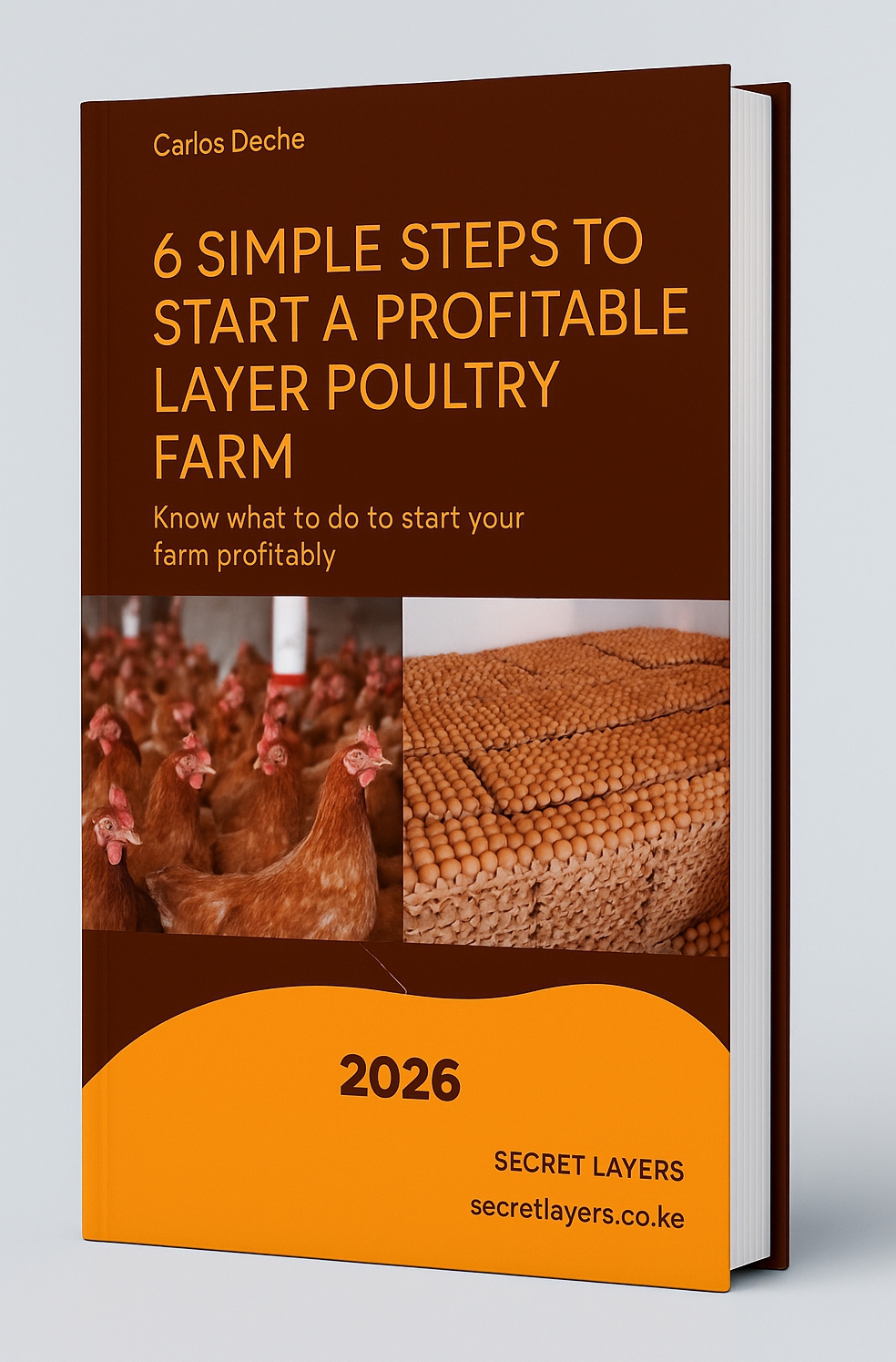
    If you are reading this and you haven’t started your farm yet, check out this Free Layer Poultry Farming Guide I prepared to help you start and run a layer poultry farm profitably. Avoid the trial and error and get a clear plan to follow.
    Free beginners guide to starting a profitable layer poultry farm. Step by Step guide.
    Name
    Limited access. Join other serious farmers who have taken the guide and get support.

    See you next Friday!
  • Don’t Buy Point Of Lay Chicken Before Checking These 7 Things(Non-Negotiable)

    So, you’ve read my Day Old Chicks vs Point Of Lay breakdown. You’ve seen the reasons. And now you’ve decided to go with Point Of Lay Chicken.

    Great choice.

    However, buying point of lay chickens is not as simple as showing up and paying. If you rush that step, you can lose money before your birds even lay their first egg.

    Because of that, you need a system.

    In this post, I will show you exactly how to choose point of lay chickens using a simple 7-point checklist. These are the things that protect your money and set your farm up to win.

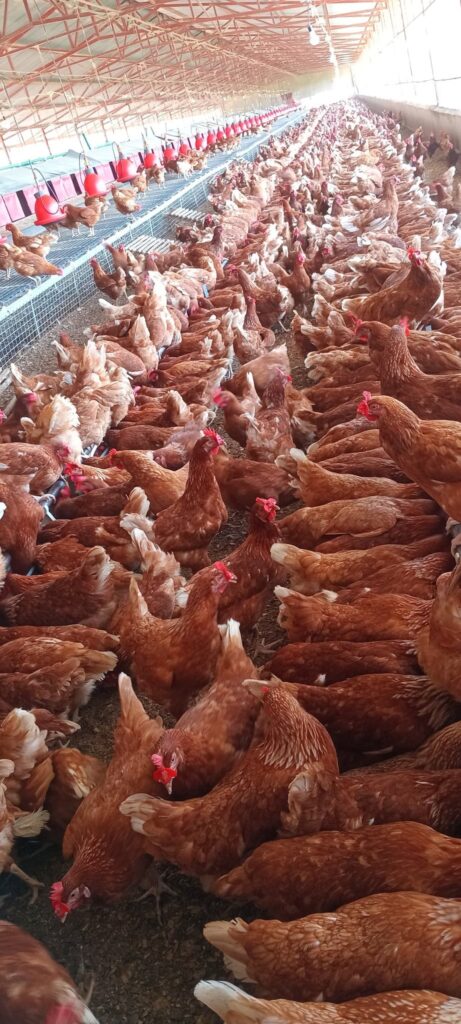
    Many layer chicken kept for eggs in a big poultry house.
    Point of lay chicken in a massive layer poultry farm.

    1. The Seller

    First, look at the person selling the birds.

    This is not optional. In fact, ignore this at your own risk.

    You are not just buying chickens. You are doing business with a human being. And not every person deserves your money.

    So ask yourself:

    – Is this seller trustworthy?
    – Does he keep his word?
    – Would you buy from him again?


    On the other hand, some people have a history. They lie. They cheat. They change stories. Many farmers lose money this way, not by bad luck, but by bad people.

    Because of that, do your due diligence.

    People do business with people they like and trust. Therefore, if something feels off, walk away. Another seller will always exist.


    2. Health Of The Birds

    Next, check the health of the chickens.

    Healthy birds make money. Sick birds kill farms.

    As soon as you arrive at the farm, start observing. Use all your five senses. This is one of the fastest ways to understand what you are dealing with.

    But here I’ll show you how to use three.

    First Listen.

    Are the birds making sound? A healthy flock is active and noisy. Weak birds are often quiet.

    Then Look, carefully.

    Check how they move. Watch how they eat. Observe how they scratch and peck. Also look at their feathers, their eyes, and even their droppings.

    After that, touch them.

    Feel the feathers. Check the comb. Notice the body condition. A good bird should feel strong, not weak or light.


    Finally, weigh a sample.


    You do not need to weigh all birds. Still, take a reasonable sample size. Weight helps you estimate age and feeding quality.

    Because of this, health and weight work together. If both are off, that is a red flag.


    3. Vaccination Record

    Now, ask for the vaccination record.

    Many farmers ignore this step. Others do not even know they should ask.

    But vaccination is not optional. It is critical for survival.

    Most sellers will tell you their birds are vaccinated. Do not trust words. Ask for proof.

    You need to see the actual record.

    If it is not documented, it was not done.

    In medical school, we follow a simple rule: if you did not write it, you did not do it to the patient.

    The same logic applies here.

    So, check the document. Confirm the dates. Make sure it makes sense.

    If the seller cannot provide it, assume the birds are not vaccinated.

    Therefore, unless you want future problems, walk away.

    4. Breed

    Next, confirm the breed.

    This is very important.

    There are real cases where farmers buy birds thinking they are commercial layers. Months later, production stays below 50%.

    Why?
    Because they bought improved chickens instead of hybrid layers.

    Breed determines productivity.

    No matter how well you feed a local or improved bird, it will not perform like a hybrid layer. It was not designed for that.

    Because of this, verify what you are buying.

    If possible, carry an expert. Alternatively, learn basic breed identification yourself.


    5. Sex Of The Birds

    Then check the sex.

    It sounds obvious, but mistakes happen.

    Imagine buying 1,000 point of lay chickens. You prepare your farm. You wait for eggs. Then one day, your neighbour visits your farm and tells you you have nice cocks.

    Yes, it happens.

    And it is costly.

    Because of that, confirm the birds are female.

    Learn how to identify them. If you are not confident, bring someone who is.

    This step alone can save your entire investment.


    6. Age Of The Chicken

    Next, confirm the age.

    Age affects both price and production timing.

    Point of lay chickens should be close to laying. If they are too young, you will spend more time feeding them before seeing returns.

    One way to estimate age is through weight. That gives you a rough idea.

    However, do not rely on guesswork alone.

    Ask for proof.

    Request documents showing when the birds were purchased or delivered. This can be invoices, records, or even dated photos.

    Make sure you combine your observation with evidence.

    Never depend on assumptions.

    7. Price

    Finally, comes the price.

    Business must make sense for both sides.

    The seller wants profit. You also need profit. That means the deal must be a win-win.

    Because of that, go prepared.

    Know your numbers before you arrive. Understand the maximum price you can pay and still make money during the laying cycle.

    Do not guess. Do not hope. Calculate.

    While negotiating, be fair.

    Do not pressure the seller too much. Sometimes people are selling because they are struggling. Do not exploit that.

    At the same time, do not get pressured.

    Some sellers will justify very high prices with long stories. Stay calm. Stick to your numbers.

    If the price does not work, walk away.

    So now you know how to choose point of lay chickens the right way.

    This system protects your money.

    With this checklist, you are not guessing anymore. You are making a decision like a serious farmer.

    And that is how profitable farms are built.

    One Last Thing

    Buying POL does not mean you should ignore brooding.

    Every poultry farmer must understand brooding. Things change. Plans fail. Sometimes you will need to start with day-old chicks.

    So be prepared.

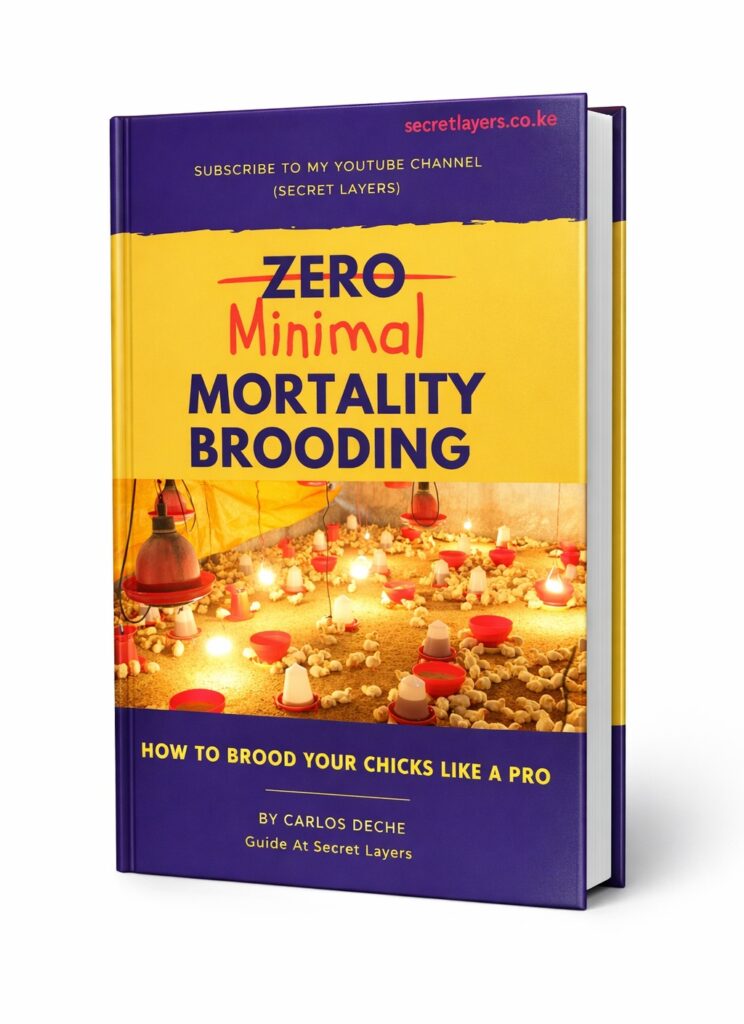
    If you want to learn how to brood chicks like a pro, I created this Free Brooding Guide for you.

    Free Brooding Guide For Poultry Farmers. Zero (Minimal) Mortality Brooding. How To Brood Your Chicks Like A Pro. By Carlos Deche Guide At Secret Layers
    Name
    Limited access. Join other serious farmers who have taken the guide and get support.

    Get your copy. Study it. Use it.


    See you next Friday!
  • The 7 Farming Books That Will Make You A Millionaire

    So you want to become a successful farmer, and everyone keeps telling you to read books.

    The problem is, most farmers do not have the time for that.

    Over the past two years, I have gone through hundreds of books.
    More than 40 of them were focused on farming.

    Some were practical.

    Others were too focused on specific farms.

    A few were very general.

    Some were investigative.

    Others were memoirs.

    These are the ones I liked most.

    In this post, I will break down 7 of those books into the core lessons you can actually use on your farm.

    Now, I am still in the building and learning phase of my farming journey (as of 2026).

    Most of my time has gone into studying, observing, and learning from successful farmers across Africa and the world.
    That is how I have been preparing to do this the right way.


    If you apply the lessons in this post, you will have a clearer direction and stronger principles for your farm.

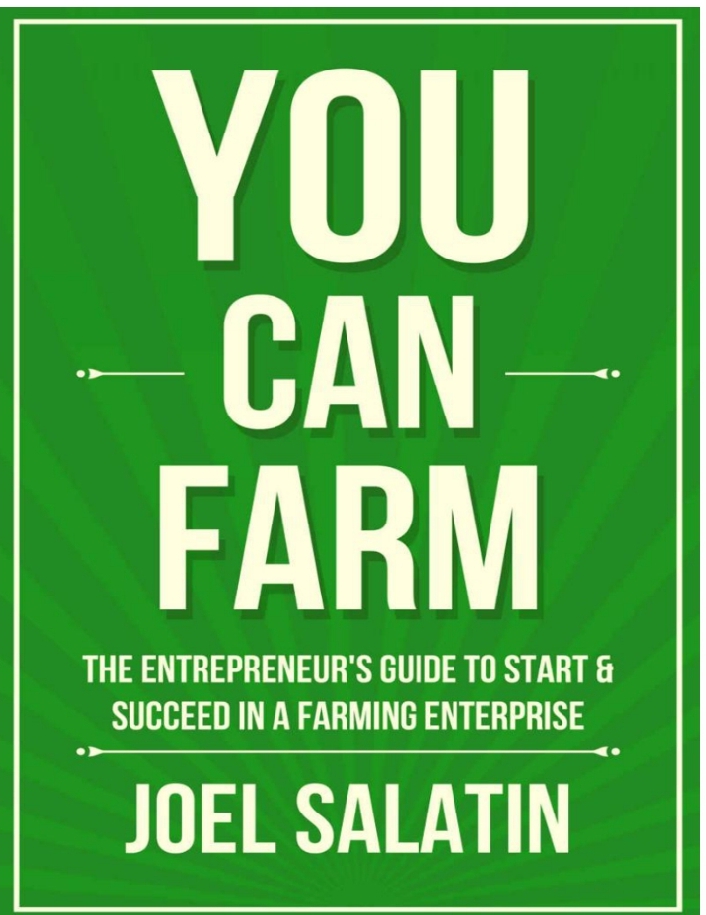
    1. You Can Farm by Joel Salatin

    This is the first farming book I ever read.
    Joel Salatin is one of the most well-known farmers in the world.

    Search his name and you will quickly see his strong views on farming and even politics.

    He has written over 14 books and co-authored others.
    And yes, he is a farmer.

    So much for the idea that farmers are not thinkers.

    You can farm - Farming book by Joel salatin
    You Can Farm by Joel Salatin. The first ever farming book that I read.

    Here’s What You’ll Learn..

    How to develop a vision for your farm.
    Many farmers ignore this at the beginning.
    Later, they are forced to figure it out the hard way.


    The 10 commandments for succeeding in farming.
    These focus on discipline and commitment.
    One key idea he emphasizes is being resourceful, which is something I strongly agree with as I say in my DR.STARR Framework.

    How to start and grow your farm
    You do not have to stay small or repeat the same thing for years.

    2. Your Successful Farm Business by Joel Salatin

    One of the best pieces of advice I ever heard is this: read authors, not just books.

    That is why I picked another book by Joel.

    Compared to You Can Farm, this one focuses on running the farm as a business.

    Here’s What You’re Going To Learn…

    Principles for running a farm business.
    Can you imagine, these include living frugally.
    Many farmers make money, then spend it badly and struggle the next season.


    Direct marketing
    Selling directly to customers is one of the best ways to increase profit.


    Using a team well
    A team is not a problem.
    Think of it like adding a turbo to your farm when managed properly.


    New opportunities in farming
    These include agritourism, edutainment, and farm schools.

    3. Start Your Farm by Forrest Pritchard and Ellen Polishuk

    If you have common questions about farming, this book answers them.

    Ellen and Forrest go deep into beginner concerns.

    This Is What You’ll Learn..

    How to learn farming
    You do not always need formal agricultural school.

    Do you need land to start?
    The answer is not always what people expect.


    The importance of the market
    This is one of the strongest parts of the book.
    It is given a lot of attention for a reason.
    I have talked about this many times.
    The market is often more important than capital.
    Many farmers ignore this, get into production, and struggle later.
    I almost made the same mistake myself.

    4. Mini Farming by Brett L Markham

    If you are concerned about the food you buy and want to produce your own, this book is for you.

    Many people think lack of land is the main problem.

    That is not always true.

    What You’ll Learn In This Book..

    You do not need large land.
    Not 10 acres.
    Not 5.
    Not even 1 acre.
    You can farm on 1/4 acre

    That small space can support crops, poultry, and livestock.

    How to become self-sufficient
    You can produce most of your food at home.


    How to preserve and sell surplus
    Extra production should never go to waste.

    5. Glorious Beef by Pat La Frieda

    Think about this for a moment.

    What if your farm supplied top restaurants and supermarkets in your country?

    That is the level this book shows.

    It is a story of how a small family business grew into a multimillion-dollar company.

    Here’s what You’ll Learn..

    Farming is business
    Decisions matter just as much as production.


    How to grow a serious operation
    You see what it takes to build something big.


    Working with other farmers
    Collaboration can help you scale.


    Understanding product quality
    Knowing what makes the best product (beef, meat, eggs or whatever) is part of the business.

    After reading this, I started thinking differently about the quality of food that I eat,especially beef.

    6. Invisible Giant by Brewster Kneen

    Have you ever heard of Cargill?
    It is one of the largest private companies in the world.

    At one point(2025), it had over 150,000 employees and revenue over $150 billion.

    This book shows what it takes to build something like that.

    Here’s What You’ll Get From It..

    Understand scale.

    Big companies grow through systems and time.


    Applying the lessons on a small farm.
    You can still use these ideas even at a small level.


    Think big
    Growth starts with mindset.
    You may not build something that large.
    Still, the thinking can push you ahead of many farmers.

    7. 40 Chances by Howard G Buffet,with Howard W Buffet, forwarded by Warren E Buffet

    Yes, this is from the Buffett family.

    Three generations connected to business and impact.

    This book focuses on purpose.

    What You’ll Learn..

    You only have a limited number of seasons
    Farming time is not endless.

    About 40 to be exact. Hence the name 40 Chances.


    Purpose matters
    Farming is not just about money or status.


    You need direction
    Vision, mission, and values keep you going when things get hard.


    Farming affects the world
    Food production connects to hunger and global challenges.


    This book helps you see farming in a bigger way.


    These are the 7 books I wanted to share with you.

    As you can see, farming is not just about farming.
    There is business.
    There is self-sufficiency.
    There is purpose.


    I will keep updating this list as I continue learning.

    You only need one idea from a book to change your farm.
    And you never know which book that is.

    Before You Go

    I am currently writing a book for farmers whose main theme is ‘Before You Start Your Farm’

    If you’re reading this after the book is out, make sure you get yourself a copy.


    For now, I have created two simple guides:


    If you want to start a profitable layer poultry farm, get this Free Guide.

    Free beginners guide to starting a profitable layer poultry farm. Step by Step guide.
    Name
    Limited access. Join other serious farmers who have taken the guide and get support.


    If your chicks keep dying in the first month, get the free brooding guide.

    Free Brooding Guide For Poultry Farmers. Zero (Minimal) Mortality Brooding. How To Brood Your Chicks Like A Pro. By Carlos Deche Guide At Secret Layers

    Name
    Limited access. Join other serious farmers who have taken the guide and get support.

    Both are practical and easy to apply.


    See you next Friday!

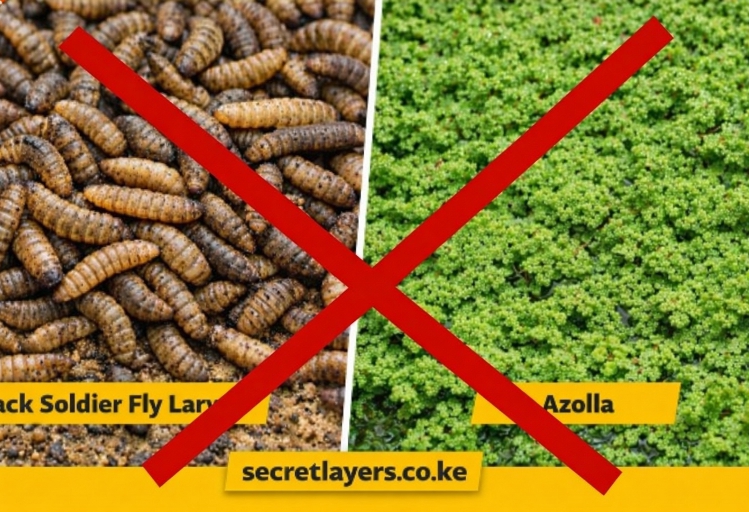
  • 5 Reasons Why I Will Never Use Azolla Or BSFL On My Farm

    Save feed costs on your poultry farm!
    Use azolla! Use black soldier fly larvae! Use hydroponic fodder!

    These are ideas you hear everywhere as creative ways of lowering poultry feed costs on your farm. In fact, azolla is the most popular of them all and has gained global attention.

    Last week, I made a post about 4 cheap poultry feed options you can use on your poultry farm.

    These feed sources promise many farmers something very attractive. Moreover, the promise is not only for poultry farmers but also for livestock farmers.

    The promise is simple.

    First, they say you will make more profits. Second, they claim you can defeat what I call the biggest monster in poultry farming — feed costs.

    However, is it really true? Do these cheap poultry feed alternatives really increase profits the way marketers claim?

    Meanwhile, businesses have been built around azolla and black soldier fly larvae poultry feed (BSFL). Some entrepreneurs even produce tonnes of BSFL every week.

    In addition, influencers have built entire online brands around azolla farming.

    Therefore the real question becomes this:
    Are these alternative poultry feeds truly helpful, or are they just another gimmick that keeps farmers stuck in the same vicious cycle?

    In this blog post, I will give you five reasons why I would never use alternative poultry feeds on my farm.

    However, there is one condition where I would use them. Keep reading to find out.

    1. They Are For Small Farms

    You have a 10,000 layer chicken farm. Alternatively, imagine running a 100-cow dairy farm.

    Would you consider using black soldier fly larvae poultry feed for your chickens?
    Or would you consider using azolla as cattle feed supplement?

    Maybe you said yes. And honestly, I respect that.

    However, I would not.

    Think about the scale for a moment.

    How many tonnes of BSFL would you need for the chickens? Likewise, how many tonnes of azolla would your cows require?


    To make it worse, how many truckloads of garden or kitchen remains would you need to produce that amount?

    The truth is simple. Most alternative poultry feeds work very well for small farms.

    For example, if you have 500 chickens, azolla and BSFL can significantly reduce your poultry feed costs.

    However, these options become almost useless for large-scale farmers like in the examples above.

    A good example is Dr. Daniel Masaba, one of the most successful layer farmers in Uganda. He once tried using azolla and BSFL to reduce feed costs on his farm.

    However, he later abandoned the idea.
    In one of his videos, he explained that the system was not feasible for a large-scale poultry farm.
    At that time, he had around 7,500 layers.

    The reason is clear. The amount of production required to feed a large flock becomes massive.

    Therefore, without serious infrastructure and capital, producing your own alternative poultry feeds can become more expensive than simply buying commercial poultry feed.

    2. They Are Not Nutritionally Sufficient

    Another problem is that alternative poultry feeds are not replacements for commercial poultry feed.
    Instead, they act as supplements.

    In other words, they are similar to the vitamins and minerals farmers add to feed. However, in this case, you must use larger quantities.

    That is where the problem starts.


    Yes, these feeds may reduce costs. However, by how much?
    Certainly not 50%.

    By the way, tell me in the comments: what percentage of feed costs do you think azolla or BSFL actually reduce?

    Interestingly, many farmers cannot even say exactly how much money they are saving.

    Meanwhile, if azolla, BSFL, and hydroponic fodder could completely replace commercial feed, I would be among the first people to use them.

    Why?
    Because feed prices are brutal right now. Every poultry farmer knows that feed costs are killing profits.

    But the reality is different.
    Even after preparing these alternative feeds, farmers still have to buy commercial poultry feed.

    Therefore the farmer does extra work while still paying the same major cost.
    For me, that is still a tough game.

    3. You Cannot Measure The Nutrients

    Layer chickens and broilers both require very specific nutrition at different stages of growth.

    For example, growing layers need higher protein levels. Later, laying hens require higher calcium levels for strong eggshells.

    Fortunately, commercial feed companies calculate these values very carefully.

    As a result, each bag of poultry feed contains balanced levels of:

    -Protein

    -Energy

    -Calcium

    -Vitamins

    -Minerals

    Because of this system, guessing is removed and errors are very unlikely.

    However, the same cannot be said for most alternative poultry feeds.

    Standard nutrient estimates exist for azolla and BSFL. Unfortunately, those numbers may not match what you actually produce.

    For example, how much protein is in your azolla pond today?

    Even worse, how much protein is in your leftover cabbage or kitchen remains?

    Honestly, you cannot know unless you send the sample to a laboratory.
    As a result, birds may receive insufficient poultry nutrition.

    Eventually, that problem begins to show in production.

    You may start seeing:

    -Fewer eggs

    -Small egg size

    -Weak eggshells

    Sadly, many farmers blame the feed company.
    Meanwhile, the real cause might be the alternative poultry feeds being used.

    4. They Are Hard To Produce Consistently

    Personally, I like simple systems most of the time.

    If you also like simple systems, I created a Free ebook for you.

    It is a guide for starting and running a profitable layer poultry farm.

    Free beginners guide to starting a profitable layer poultry farm. Step by Step guide.
    Name
    Limited access. Join other serious farmers who have taken the guide and get support.

    Gey your copy Now!

    Now let’s compare the effort involved.

    Compared to producing your own formulated poultry feed, raising azolla or BSFL may seem easier.

    However, compare those systems to simply buying ready-made commercial poultry feed.

    In that situation, I would still choose commercial feed.

    The reason is consistency.

    Producing alternative poultry feeds correctly requires several steps:

    -Proper preparation

    -Understanding the nutrient composition

    -Formulating correct feed ratios

    -Maintaining the system daily

    In addition, farmers must do this every single day to keep results stable.
    Therefore the system becomes harder than simply purchasing high-quality poultry feed.

    However, if the benefits clearly outweigh the extra effort, then the work may be worth it.

    Ultimately, that decision becomes a personal choice for each farmer.

    5. Health Risks To Your Chicken

    Imagine trying to reduce feed costs and accidentally killing your chickens.

    That situation would be a farmer’s worst nightmare.

    Fortunately, reported cases of problems from alternative poultry feeds are rare.

    However, rare does not mean impossible.

    Commercial poultry feeds are usually processed under controlled conditions. In addition, they often contain coccidiostats and quality controls.

    Meanwhile, homemade feed systems can introduce new risks.


    For example, kitchen remains might already be decomposing, food remains may contain spices or substances harmful to poultry.

    Azolla can also become dangerous if it grows in dirty or contaminated water.
    Poor storage can also lead to spoilage or fungal growth.

    Meanwhile, black soldier fly larvae can transmit disease if they are reared or stored in unsanitary conditions.
    Although such problems are uncommon, they are still possible.

    Unfortunately, farmers may not even realize that the alternative poultry feed is the real cause of illness in their birds.

    When Would I Use Azolla Or BSFL?

    Those are the five reasons I would not use alternative poultry feeds on my farm.

    However, there is one situation where I might use them.

    That situation is simple.

    I would consider them only if I planned to run a small farm.

    However, that is not my plan.

    In fact, the book I am currently writing contains a full chapter called “Before You Start Your Farm.”

    One key idea in that chapter is this:
    Think big. Build big.

    That message is also central to the Secret Layers community.


    Earlier, I published a post about five powerful solutions to high animal feed costs.

    In that article, my first solution was simple:
    Go big.

    Large-scale farms benefit from economies of scale, better systems, and stronger profit margins.

    Therefore my advice is clear.
    Do not think small.
    Do not stay small.
    Most importantly, do not fall into the trap of farming trends that do not scale.


    See you next Friday!

    secretlayerske@gmail.com
    carlosdeche4040@gmail.com

  • 4 Cheap Poultry Feed Options That Will Save You Money

    Feeds will kill your poultry business!

    But cheap poultry feed alternatives could save it.

    This is one of the first lessons farmers learn when they research the poultry business.

    Unfortunately, many beginners never research first. As a result, they pay dearly for that ignorance later.


    The reason is simple. On most poultry farms, feed alone takes 60–70% of the total production cost.
    Even worse, that cost can rise to 80% if feeding is poorly managed.

    Meanwhile, the commercial poultry feed business is a powerful industry on its own. In many cases, it is more profitable than poultry farming itself.


    For example, in 2026 De Heus Nutrition, one of the largest animal nutrition companies in the world, opened a new feed plant in Kenya.

    Interestingly, this happened despite the hundreds of animal feed companies already operating in the country.

    So why would such a big company still invest here?

    Clearly, the answer is simple. Feed demand is enormous.

    And because poultry feed is expensive, farmers have always looked for ways to lower this major cost.

    Therefore, many have experimented with cheap poultry feed alternatives.
    These options help farmers reduce reliance on commercial feeds.

    After all, commercial feeds are often expensive and sometimes unsustainable for small farmers.

    Personally, I have seen some farmers succeed with these alternatives. However, I do not have exact figures showing how much their feed costs dropped or how much their profits increased.

    Nevertheless, this post will introduce several cheap poultry feed alternatives used by farmers.

    Black soldier fly larvae vs azolla
    Before we start, which one would you use between these two?
    Let me know in the comments.

    First, let me make something clear.

    From what I have seen, these options work mostly for small poultry farms.

    Large commercial layer farms rarely depend on them.
    Therefore, if you run a small-scale poultry farm, this information will help you.

    1. Azolla

    Among all cheap poultry feed alternatives, Azolla has gained massive attention worldwide.
    In fact, many farmers see it as a small miracle plant.

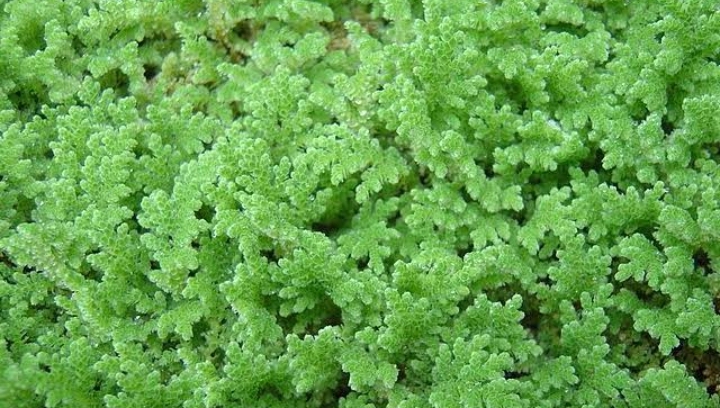
    Scientifically, Azolla is a small aquatic fern. It grows quickly and can double its size every 72 hours.

    Because of this rapid growth, farmers can produce large amounts with very little space.

    Azolla.A cheap alternative feeds for poultry and livestock farmers.

    Additionally, Azolla contains high levels of protein and other nutrients useful for chickens.

    Another advantage is its simplicity. Farmers can learn how to grow Azolla in just a few hours.

    After harvesting, it can be fed fresh from the pond. Alternatively, farmers can dry it before feeding.

    However, there is one important warning.
    Azolla should only be used as a supplement, not a complete feed.

    Never feed chickens only Azolla.

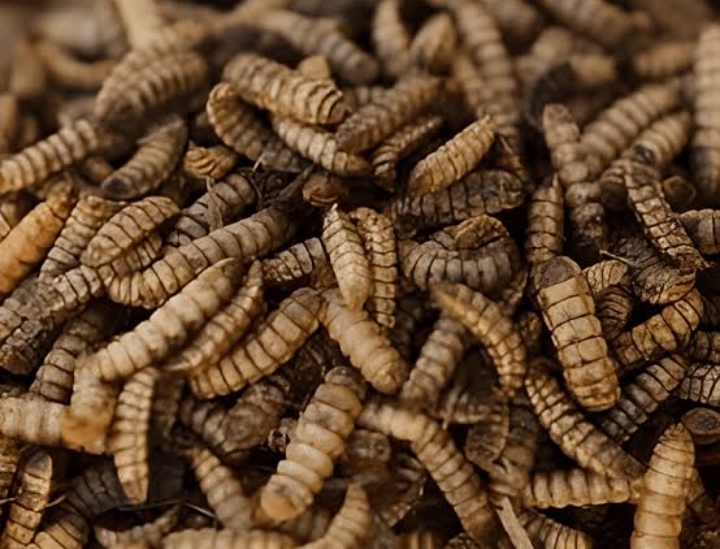
    2. Black Soldier Fly Larvae

    Black soldier fly larvae

    If Azolla is Breaking Bad, then Black Soldier Fly Larvae are Better Call Saul.
    Although not as popular as Azolla, this option is also powerful.

    Black Soldier Fly larvae come from the black soldier fly insect. Farmers raise these flies using organic waste.

    During feeding, the flies lay eggs. Soon after, the eggs hatch into larvae.

    This process usually takes 10–15 days.

    These larvae contain extremely high protein levels. In fact, they contain more protein than Azolla.

    Because of this, many farmers use them to replace part of the commercial feed protein.


    Moreover, the system is simple. It is also fast and relatively cheap.

    As a result, many farmers consider this one of the best cheap poultry feed alternatives available.

    3. Hydroponic Fodder

    Another interesting option is hydroponic fodder.

    Many people believe hydroponics is part of the future of agriculture.

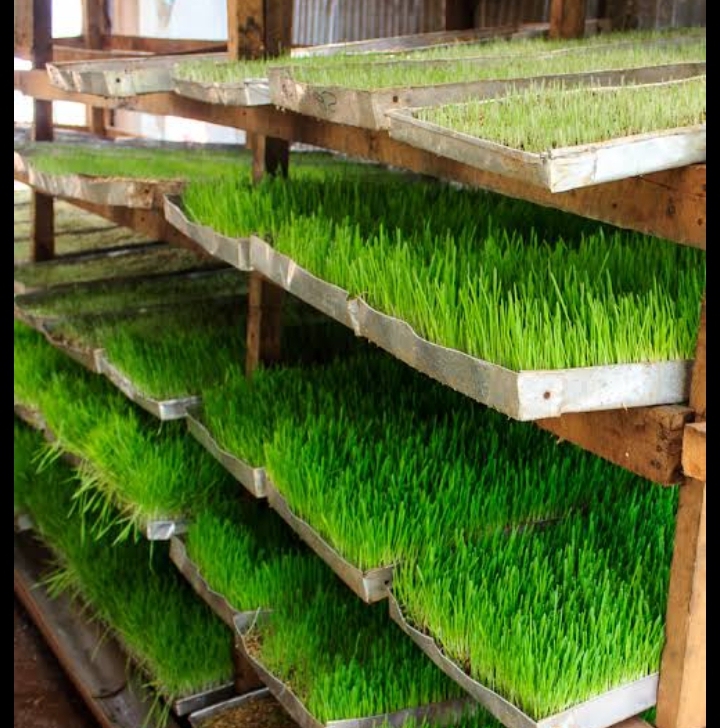
    Unlike traditional farming, hydroponics grows crops without soil.

    Hydroponic fodder


    In this system, barley seeds are placed in trays and watered regularly.
    Within a few days, the seeds sprout into soft green fodder.

    At that stage, the young plants are fed directly to chickens.

    Unlike Azolla and larvae, hydroponic fodder mainly provides energy.

    Because of this, it can replace part of the energy portion of poultry feed.

    Furthermore, it grows quickly and requires very little land.

    Farmers also need no special degree or training to start.
    With small effort, this method can help reduce feed expenses by big margins.

    Before You See The Last Option,

    Get a Free copy of my Ebook on starting and running a profitable layer poultry farm👇🏿

    Free beginners guide to starting a profitable layer poultry farm. Step by Step guide.
    Name
    Limited access. Join other serious farmers who have taken the guide and get support.

    4. Garden Or Kitchen Food

    At home, I often struggle with free-range chickens during planting season.🥲

    They wait for maize to sprout. Then suddenly, they eat all the young leaves.

    Soon after, the plants grow again.

    Unfortunately, the chickens return and eat them again.

    Clearly, chickens love green plants.

    Because of this, some farmers use greens as another feed source.
    They usually do this in two ways.

    Planting Greens For Chicken

    Green plants are loved by chicken and can be used to lower feed costs.

    First, farmers can plant crops specifically for poultry.

    Common choices include maize, spinach, kales, and different grasses.

    Later, farmers either harvest the leaves or allow chickens to forage directly.

    However, layer chickens are usually kept indoors.Therefore, the farmer simply cuts the greens and carries them to the poultry house.

    Using Kitchen Food Remains

    Using Kitchen Food Remains
    Second, farmers can feed chickens vegetable leftovers from the kitchen.

    After all, most homes produce some food waste every day.

    Instead of throwing it away, farmers can give it to their chickens.


    However, this method has one weakness.

    Kitchen waste is not always reliable.

    For example, what happens when you eat out?

    What happens when you cook less food?

    Because of this, kitchen waste works best as an occasional supplement.

    Finally..

    These are the four main cheap poultry feed alternatives used by many farmers.

    Remember, listing them does not mean every farmer should use them.

    Each option has its own limitations.

    Therefore, you must evaluate what works best for your farm.
    Large layer farms usually prefer commercial feeds or professionally formulated feeds.

    Meanwhile, if you’re a small-scale farmer you can experiment carefully with these alternatives.

    If you want to see my personal recommendations for reducing feed costs, Read Here


    Finally, watch out for my next post.
    In that article, I will explain why I personally will not use any of these alternative feeds.


    See you next Friday!

    secretlayerske@gmail.com

    carlosdeche4040@gmail.com

  • Vaccination Schedule For Layers : A Simple Guide For Farmers


    Are you confused about which vaccines to give your layers and when to give them?


    Many farmers feel frustrated because there are different vaccination schedules for layers online. Even reputable hatcheries sometimes give slightly different timelines.


    I will make it simple for you in this post.

    But before we see the full vaccination schedule for layers, here are 5 key things every farmer should know:

    1.Local Diseases Matter

    Different areas have different common poultry diseases.
    For example, in areas with infectious coryza, the coryza vaccine will be included in the schedule.


    Tip: Check with neighbors or your local vet to know which diseases are common in your area. This will help you plan your vaccines better.

    2.Most Schedules Have The Same Vaccines

    Common vaccines include: Marek’s, Newcastle (ND), Gumboro (IBD), Fowl Pox, and Fowl Typhoid.
    You will see these in most schedules.


    Tip: Keep a small notebook with your vaccination dates. It makes it easy to track boosters and avoid missing doses.

    3.Timings Can Be Confusing

    Different schedules online can seem very different. Don’t panic. Focus on the principles.


    Tip: Don’t compare schedules from different regions. Focus on what matches your region and farm conditions.

    4.Follow Your Hatchery

    Always use the vaccination schedule given by your chick supplier.
    Registered and licensed hatcheries know what works best for your area.


    Tip: If your supplier gives a printed schedule, keep it in a safe place. Refer to it every week to stay on track.

    5.Consult A Local Poultry Vet

    Even if your supplier gives a schedule, a local vet can advise you based on diseases common in your area.


    Tip: Even a quick phone call can save you money and prevent disease outbreaks.


    These five principles will save you confusion and help you vaccinate your layers properly.

    Common Patterns In Vaccination Schedules

    After reviewing many schedules online, I found two main patterns:


    Simple schedules: Direct, easy to follow, covering common diseases.


    Complex schedules: From licensed hatcheries like Kenchic. More detailed but credible.


    Both work if you follow the 5 key principles above.

    What I Use For My Birds

    I follow the schedule given by my supplier.


    I follow the Kenchic schedule because I buy my chicks from them and my farm is in Kenya.

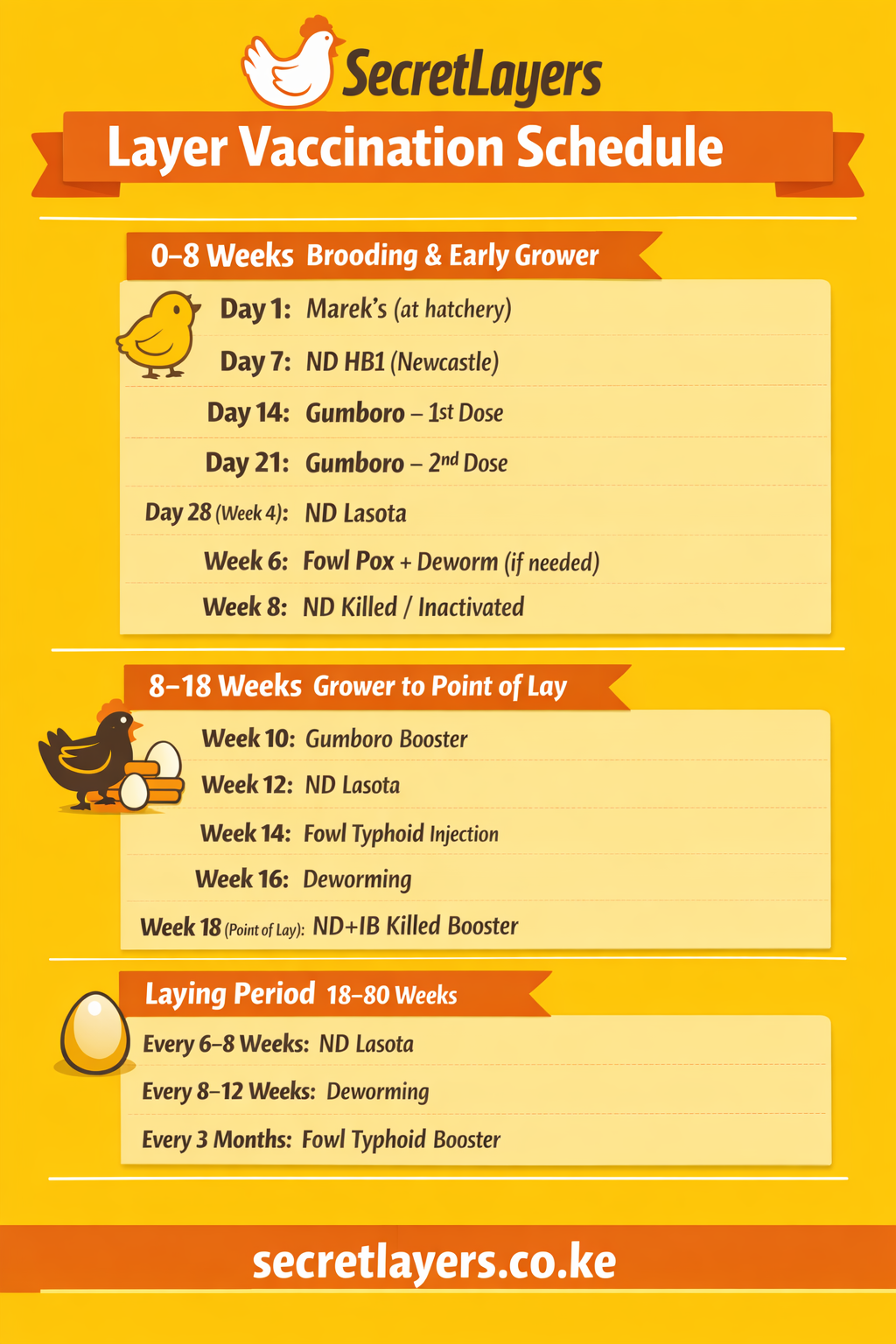
    Vaccination Schedule 1 (Simple)

    0–8 Weeks: Brooding & Early Grower Stage

    Day/
    Week
    VaccinationMethod
    1MareksAt Hatchery
    7New Castle -HB1Eye drop
    Drinking water
    14Gumboro
    (IBD) – First
    Drinking water
    21Gumboro
    – Second
    Drinking water
    28New Castle -LasotaDrinking water
    Week 6Fowl PoxWing stab
    Week 8New Castle – LasotaInjection


    8–18 Weeks: Grower to Point of Lay

    WeekVaccinationMethod
    10Gumboro
    (If disease high in your area)
    Injection
    12New Castle – LasotaDrinking water
    14Fowl
    Typhoid
    Injection
    16Deworming
    18New Castle
    Sometimes plus IB
    Injectiom


    Laying Period (18–80 Weeks)

    WeekVaccinationMethod
    Every 6-8 weeksNew Castle – LasotaDrinking water
    Every 8-12 weeksDeworming
    Every 3 weeksFowl Typhoid booster
    Vaccination schedule for layers - secret layers
    The simple vaccination schedule for layers by Secret Layers

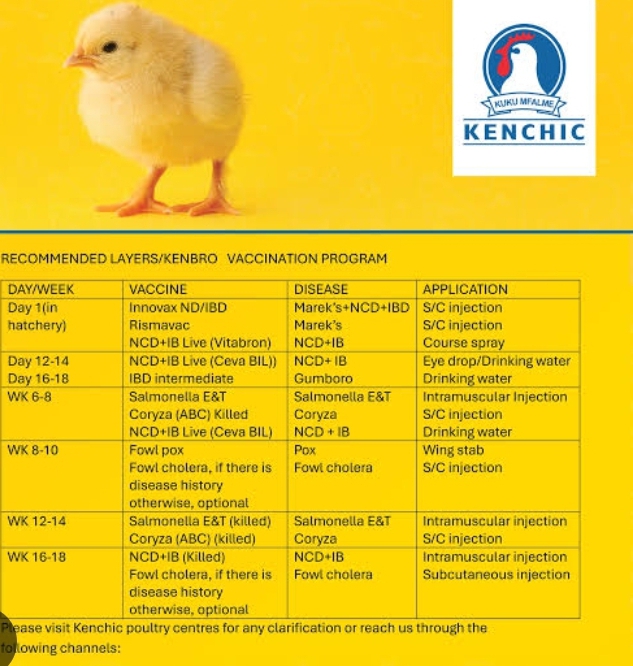
    Vaccination Schedule 2 (Kenchic)

    Kenchic vaccination schedule for layers at secret layers
    Kenchic vaccination schedule for layers


    Note: Kenchic’s schedule is more detailed, which is helpful for larger farms or areas with high disease pressure.

    Follow and stick to your supplier’s recommended schedule.


    Following a proper vaccination schedule for layers protects your birds, saves money on vet bills, and keeps egg production steady.
    Even small farms can achieve healthy flocks if vaccines are given on time.


    Let me know in the comments if you use a different schedule or have any tips to share.


    I publish weekly videos on starting and running a profitable layer poultry farm on my YouTube channel.
    Subscribe so you don’t miss the next video👇🏿

    https://youtube.com/@secretlayerske?si=bWp5FOirXm6kyXrg


    See you next Friday!

    carlosdeche4040@gmail.com secretlayerske@gmail.com

  • 6 Reasons Why I Chose Day Old Chicks Over Point Of Lay

    I have been having a debate with myself for quite some time about whether I should choose day old chicks or just buy point of lay birds.

    If you’re interested in layer poultry farming but you haven’t started yet, you’re more likely to face the same dilemma.

    Should I buy day old chicks and raise them for about five months before I start earning, or should I buy point of lay birds and start making money next week?

    This was so real for me that I ended up writing a blog post about the differences between day old chicks and point of lay to help anyone struggling with the same issue.

    And if you’ve been a follower of my Facebook and X (which I highly recommend you follow by the way… you’re missing a lot), you already know I prefer day old chicks to point of lay birds.

    In this post, I’m going to show you why I chose day old chicks—not to convince you, but to show you my thought process. Hopefully, you’ll learn something from it.


    1. Little Capital Required To Start

    One day old layer chick costs around Ksh.150 right now(2025), while point of lay birds cost between Ksh.500–Ksh.1500, depending on age and seller.
    For me, day old chicks are a better option because they require less money to acquire the birds.

    At first, I won’t have that much capital. Day old chicks give me a chance to start with a small budget and grow from there. This doesn’t include the cost of feeding for the 4.5 months, but at least I can start the poultry business with little money and buy more feed as I continue.

    Let’s say I want to start with 100 birds.

    🔴Day Old Chicks

    Day Old Chicks cost
    100 × 150 = Ksh.15,000

    Each bird needs about 1.25kg in 8 weeks
    100 birds × 2.5 = 250kg
    One 50kg bag = Ksh.4,000

    Cost of 250kg

    250 × 4000/50 = Ksh.20,000

    Total = Ksh.35,000


    🔴Point Of Lay

    Point of lay birds cost

    100 × Ksh.850 = Ksh.85,000

    Total = Ksh.85,000


    And that’s just the birds. I haven’t bought even one bag of feeds.

    So you see the difference. A huge Ksh.50,000.

    And this is before feeds. This is why day old chicks work for me—they let me start small as I continue finding money.

    Caution: Make sure you have money to continue feeding your birds. If not, you’ll end up killing your chicks or selling them at a loss.


    2.Learning Opportunity

    A good number of people hate school, but this type of learning is different.
    And remember if you’re not learning, you’re dying.

    Humans grow when they learn new things, and that’s exactly what day old chicks offer.

    They give you a chance to learn how to:

    – Prepare before receiving chicks
    – Brood correctly
    – Follow a vaccination schedule
    – Maintain strong biosecurity


    You get to learn these for almost five months. Point of lay birds don’t give you this chance. They have already been brooded, most vaccines done, and all you get is a near-finished product.

    Where is the fun in being handed success on a silver platter?

    The amount of knowledge I’ve gained from brooding alone is massive. If I had planned to buy point of lay birds, I wouldn’t have bothered learning about brooding or vaccinations.

    3. They’re Easier And Safer To Source

    Getting 100 point of lay birds is easy.
    But what if your farm grows and now you want 5,000 birds?
    How easy will it be to source 5,000 point of lay birds from one place?
    Let me tell you—it’s as easy as getting rich quick in farming. Yes, I scared you there, but it’s true.

    As your egg business grows, sourcing point of lay birds becomes difficult. You’ll need to buy in small batches from different sellers, and I personally don’t want that.

    On the other hand, if you wanted 10,000 day old chicks today, you know where you would get them. Big hatcheries supply them all over Kenya, and they are credible compared to most point of lay sellers—mostly farmers like you and me.

    Another sourcing problem with point of lay birds is the lack of transparency.
    You don’t know:

    – If the vaccination records are true
    – If the feeding program was followed
    – If the birds are uniform
    – If the birds are healthy
    – Or even their exact age

    Many farmers buy “18-week-old” birds expecting eggs in one week, only for them to start laying two months later. Others buy mixed breeds, including dual-purpose chickens instead of hybrid layers.

    Worst of all, some farmers buy birds that fall sick or die the next day—even with updated vaccination cards.

    Imagine paying Ksh.85,000 for 100 point of lay birds only for them to die. You don’t want that.

    This almost never happens with day old chicks if you buy from regulated hatcheries.

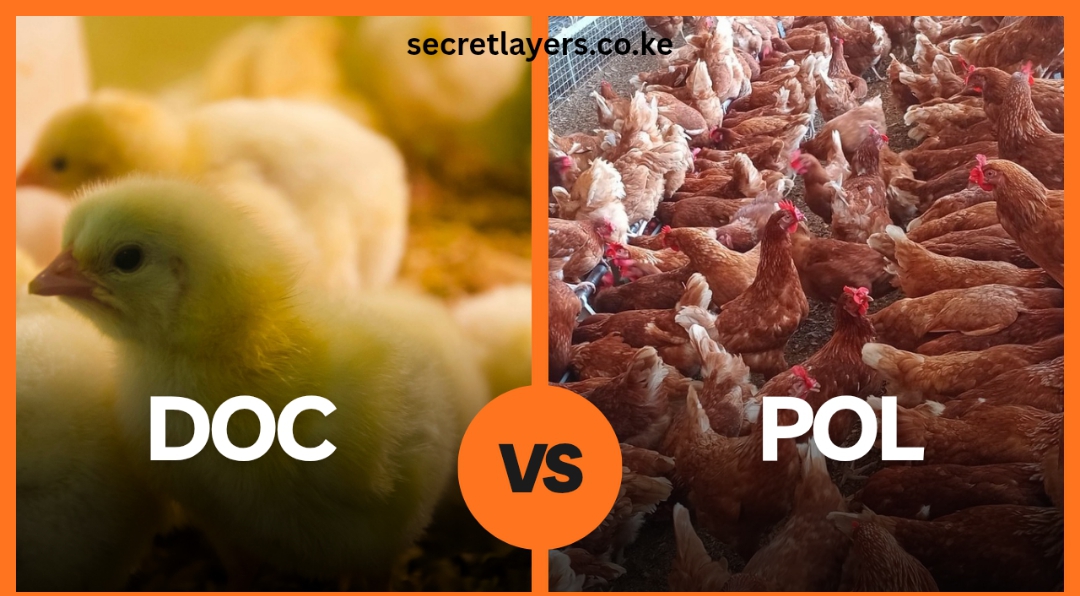
    Day old chicks vs Point of lay image
    Day old chicks vs Point of lay birds

    4. They Offer Control Over Your Business

    Day old chicks give me full control over my business.
    I choose when to stock, how to brood, what to feed, which vaccines to use, and how to raise my flock.

    You can’t do that with point of lay birds.

    What if you want to stock next month, but your supplier’s birds are still three weeks old? You wait.
    You also don’t control how they brooded, fed, or handled those birds.

    Big layer poultry farms don’t buy point of lay birds. They all buy day old chicks and raise them themselves. Why? Because control is everything. Even cost control.

    Plus remember, the seller wants profit. If their feed prices were high, they’ll pass that cost to you.

    Control your business if you want to scale your poultry farm.

    5. Profitability

    Day old chicks are simply more profitable than point of lay birds.
    The only advantage point of lay have is quick cash, which doesn’t last.

    With day old chicks, you control your production cost from the beginning.
    With time, your brooding becomes effective, mortality stays low, your cost stays down, and you get maximum production from your layers.

    This results in:

    – More eggs
    – Better profits
    – Predictable performance


    Something that is hard to achieve with point of lay birds because the foundation is out of your hands.

    And if you want, you can even sell your own point of lay birds later and profit from your skills. I’m not saying you should—but you can.


    6. Fun

    Lastly, day old chicks are fun.
    They’re like babies—many babies.
    You get them on day one of life and you raise them to maturity. They don’t get married, but they lay eggs. Hallelujah!

    By the way that’s normal😅

    The sad part is selling them off as ex-layers.

    And Fun is part of our Secret Layers core values.


    If you’re not fun, buy point of lay birds.


    Those are the six reasons why I chose day old chicks and point of lay birds.
    They give me control, the ability to scale, and I enjoy doing it.

    Let me know in the comments what you will choose for your farm—DOC or POL—and why. You might have better reasons, and I’d love to know.

    If brooding is the main challenge stopping you from choosing day old chicks, get this Free Layer Poultry Farming Guide and I’ll send you a Free Brooding Guide next.

    Free beginners guide to starting a profitable layer poultry farm. Step by step guide.

    Name
    Limited access. Join other serious farmers who have taken the guide and get support.

    See you next Friday!

    carlosdecje4040@gmail.com

    secretlayerske@gmail.com

  • Everything You Need To Know About Layer Poultry Farming

    Ludwig Wittgenstein
    ‎“The limits of my language mean the limits of my world.”


    ‎You can’t operate expertly in a field if you don’t understand the words that define it.

    ‎This is everything you should know about layer chicken, layer poultry farming and the business of layers.

    ‎The list will be updated every week with new information.

    ‎Please learn.


    Layers – Adult hens raised primarily for egg production. In layer poultry farming, layers are the backbone of your egg business, providing consistent daily eggs once they reach maturity.


    Pullets – Young female chickens, usually under 20 weeks old, that have not yet started laying eggs. Pullets are the future layers of your flock.


    ‎Day-Old Chicks (DOCs) – Newly hatched chicks, only a day old. Farmers buy day-old chicks to rear them into pullets or point-of-lay birds for egg production.


    ‎Point of Lay (POL) – Birds that are about 16–20 weeks old and ready to start laying eggs. Point-of-lay hens are ideal for farmers who want to begin egg production quickly.


    Feeder – A container or tray used to provide feed to your birds. Using the right feeder in layer poultry farming ensures minimal feed wastage and healthy growth.


    DrinkerEquipment that supplies clean water to chickens. Proper drinkers are crucial for layers’ health and optimal egg production.


    Brooding – The process of keeping chicks warm, usually with a heat source, during their first few weeks. Brooding is critical to prevent chick mortality.


    Incubator – A machine used to hatch eggs artificially by maintaining the right temperature and humidity. Incubators allow farmers to hatch chicks without using a broody hen.


    Mortality – The number of birds that die within a flock over a given period. Low mortality rates indicate good management in layer poultry farming.


    ‎Layer Mash – A balanced feed specially formulated for laying hens to maximize egg production and quality. Layer mash provides the nutrients needed for strong shells and healthy layers.


    Bird – A general term for chickens, hens, or roosters in your flock. In layer poultry farming, the term usually refers to your egg-laying hens.


    ‎Feed to Egg Conversion Ratio (FCR) – A measure of how efficiently a layer converts feed into eggs. Lower FCR means better efficiency and higher profitability.


    ‎Ex-Layers / Spent Layers – Hens that have completed their peak laying period and are no longer productive. Farmers often sell them for meat or dispose of them responsibly.


    Debeaking – A management practice where part of a chicken’s beak is trimmed to prevent feather pecking or cannibalism. Debeaking helps protect your flock in crowded layer farms.


    Culling – The process of removing weak, sick, or unproductive birds from the flock. Culling ensures only healthy layers remain for maximum egg production.


    Litter – Bedding material, like wood shavings or straw, used on the poultry house floor. Proper litter management keeps your birds healthy and reduces disease risk.


    Cages – Enclosures used to house layers, especially in commercial layer poultry farming. Cage systems help manage feed, water, and egg collection efficiently.


    ‎Newcastle Disease – A highly contagious viral disease that affects chickens, causing respiratory issues and high mortality. Vaccination is critical to protect your flock.


    ‎Infectious Bronchitis (IB) – A viral disease in poultry that affects the respiratory system and egg production. Proper biosecurity and vaccination reduce the risk.


    ‎Marek’s Disease – A viral disease in chickens that causes tumors and paralysis. Vaccinating day-old chicks helps prevent Marek’s in your flock.


    Deworming – The process of giving chickens medication to remove internal parasites. Regular deworming keeps your layers healthy and improves feed-to-egg efficiency.


    ‎Gumboro (Infectious Bursal Disease– A viral disease affecting young chickens, weakening their immune system. Vaccination protects your flock and supports healthy layer development.


    ‎Starter Mash – A high-protein feed for day-old chicks to ensure healthy growth in the first few weeks. Starter mash is the foundation for strong pullets.


    ‎Grower Mash – Feed given to pullets after the starter stage but before they begin laying eggs. Grower mash ensures proper growth and readiness for point-of-lay.


    ‎Free Range – A system where chickens can roam outdoors for part of the day. Free-range layers often produce healthier eggs and can command a premium price.


    ‎Pasture Raised – Chickens raised primarily outdoors on pasture with access to insects and grasses. Pasture-raised layers provide high-quality, nutrient-rich eggs and enjoy better welfare.

    See you next Friday!

    carlosdeche4040@gmail com

    secretlayerske@gmail.com

  • The True Cost Of Starting A Layer Poultry Farm (2025)

    You’ve decided it’s layers you want to keep on your farm, and you’re asking yourself: how much will it cost to start?
    Or maybe you haven’t decided yet. Check the reason why I chose layers here — it will help you decide👇🏿

    6 Reasons Why I Chose Broilers And Why You Should Too

    You want to know how much you’ll need to start your farm.
    You want to plan, budget, or save for it.
    And you don’t want to be caught off guard by unforeseen costs or run out of money halfway through your project.

    You’re also tired of seeing so many different startup costs on the internet.
    Well, this is the realest startup cost estimate you’ll ever see.
    This guide is for you.


    Before We Start – 3 Things To Keep In Mind

    1. No figure you see on the internet is exactly what you’ll need.
    Don’t be happy if you find it’s little, and don’t be sad if it seems too much.


    2. There are many assumptions to be made and considered.


    3. It all depends on what you want and how you want it.

    When you’re calculating the cost of starting a layer poultry farm, always remember these points. Every farm is unique.


    Key Assumptions Used In This Guide

    ✅I used a standard price of Ksh. 4,000 for a 50 kg bag of feeds (starter, grower, and layers mash).
    Feed prices vary by type and location in Kenya.

    ✅A price of Ksh. 150 per layer chick has been used (2025 prices).

    ✅Under feeds, you’ll need to prepare for starter, grower, and one month of layer mash in your startup costs.
    That covers about six months before you sell your first egg.

    ✅No construction cost is included in these startup costs.
    This is because building materials and labor prices vary widely from place to place.

    ✅Labour costs are also excluded since they differ depending on whether you hire help or work on your own.
    Remember, even if you do all the work yourself, don’t forget to pay yourself a salary.

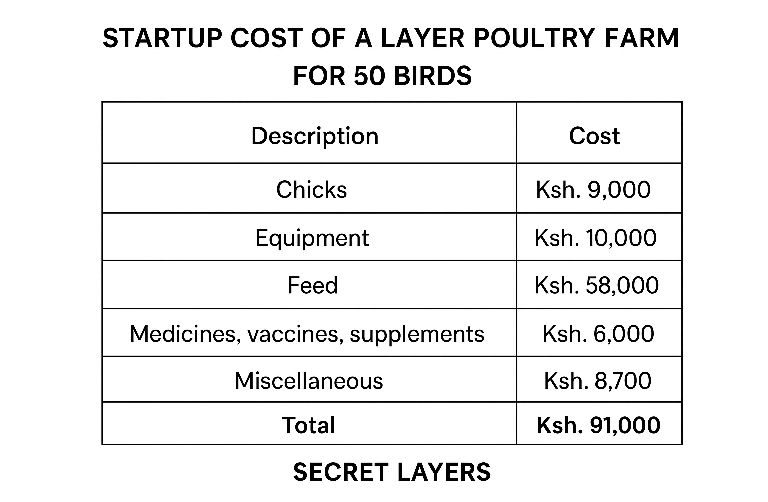
    I calculated the startup costs for 50 birds based on poll results from the Secret Layers ;

    Facebook and X pages.

    Detailed Breakdown Of Startup Costs For 50 Layers


    1. Chicks

    60 × Ksh. 150 = Ksh. 9,000
    I used 60 chicks to cover possible mortality — some chicks will die.

    Tip: Don’t forget transport costs from the distributor or hatchery to your farm. Many farmers do.
    I’ve included that under miscellaneous below.


    2. Equipment

    Estimated at Ksh. 10,000.
    I used the equipment list from this 28 equipments post and realistic prices for what’s really needed when starting small.


    3. Feed Costs


    When planning the budget for layer farming, feed is your biggest expense.
    Below is the estimate based on average poultry feed prices in Kenya in 2025.

    Starter Mash

    2.5 kg per bird in the first 8 weeks

    50 birds × 2.5 kg = 125 kg

    Since one 50 kg bag costs Ksh. 4,000:
    125 kg × 4,000 ÷ 50 = Ksh. 10,000


    Grower Mash

    9 kg per bird for 11 weeks

    50 birds × 9 kg = 450 kg

    450 kg × 4,000 ÷ 50 = Ksh. 36,000


    Layer Mash

    3 kg per bird for 1 month before you start selling eggs

    50 birds × 3 kg = 150 kg

    150 kg × 4,000 ÷ 50 = Ksh. 12,000


    Total feed cost:
    10,000 + 36,000 + 12,000 = Ksh. 58,000


    4. Medicines, Vaccines, and Supplements

    Estimated at Ksh. 6,000 from start to selling of the batch.


    5. Miscellaneous

    Estimated at Ksh. 8,700 (about 15% of feed costs)
    This covers day-to-day expenses, transport, and unexpected costs.
    Always include a buffer in your layer chicken startup costs.


    Total Startup Cost

    9,000 + 10,000 + 58,000 + 6,000 + 8,700 = Ksh. 91,000

    This is the estimated cost of starting a layer poultry farm with 50 birds in Kenya in 2025.

    How much does it cost to start a layer poultry farm? This table answers that for 50 birds
    The true startup cost of starting a 50 bird layer poultry farm in Kenya.

    Remember

    ✅ Construction costs (including cages or litter) are not included.


    ✅ I used 60 chicks to cover mortality.


    ✅ Transport costs are added under miscellaneous — most farmers forget this.


    ✅ Feed amounts include spillage and spoilage, which many startup guides ignore.


    ✅ Feed prices are standardized at Ksh. 4,000 per 50 kg bag, an average figure for 2025.


    ✅ A miscellaneous cost (15%) has been added for safety — almost everyone forgets this part.

    Practical Tips To Lower Your Startup Costs

    ✅ Buy feeds in bulk (especially starter and grower mash).


    ✅ Improvise equipment instead of buying everything new.


    ✅ For housing, repurpose an existing structure or use cheap local materials.


    ✅ Negotiate prices and avoid building a fancy chicken house just for show.

    Keeping your setup simple will significantly lower the cost of starting your farm.


    This guide has given you a realistic picture of the cost of starting a layer poultry farm in Kenya.
    With around Ksh. 91,000, you can start small with 50 layers, cover all basic costs, and begin your poultry business confidently.

    Would you start with 50 birds or more?

    Share your thoughts in the comments or tell me how you’re planning your layer poultry farming journey.

    Get this Free Layer Poultry Guide and get our regular Layer Chicken Digest Tips straight to your email.

    Free beginners guide to starting a profitable layer poultry farm. Step by step guide.
    Name
    Limited access. Join other serious farmers who have taken the guide and get support.

    See you next Friday!

    carlosdeche4040@gmail.com

    secretlayerske@gmail.com

  • How To Choose The Best Layer Breed

    You’ve decided it’s layers you’re going to keep but you don’t know what to consider when choosing the best breed for your farm.

    If you’ve not yet decided it’s layers, please check this post where I give the 6 reasons that made me choose layers over broilers before you continue.

    There are over 40 layer chicken breeds, and it can feel overwhelming to select the perfect one for your farm.

    Although I’ve already shared my list of the Top 3 layer chicken breeds, I believe it’s even more useful to give you the factors you should consider when making your choice. That way, you’ll know how to pick the breed that best fits your goals and situation.

    These are 9 factors to consider. The first 3 are general factors, while the last 6 are chicken-specific factors that focus on the characteristics of the birds themselves.

    Hopefully, by the end of this guide you’ll be able to make the right choice of breed based on facts. And the best part? You’ll also be able to advise that friend of yours who’s just getting into egg production on what they should look for.

    GENERAL FACTORS

    1. GOALS

    When given 10 days to cut a tree, I’d take the first 7 sharpening the axe. You’ve probably heard this saying before.

    But here’s the best version — I got it from Seth Godin. He says it’s not just about sharpening the axe today. Instead, it’s about going back 20 years and asking: Which tree should I plant, and where should I plant it, so I can come back to cut it down 20 years later?

    That same thinking applies to farming.

    What is your goal with layer chicken farming?

    Are you planning to have a big commercial farm?

    Do you want to sell eggs for profit?

    Or is your plan to simply get a steady supply of eggs for your family?

    Maybe you just want a pet!😂

    This matters because different breeds have different egg production levels, require different levels of care, and some can even be quite fierce — not ideal if you’re looking for a pet.

    And if you want both eggs and meat, you should consider dual-purpose breeds like Kuroiler or Kenbro.

    👉 If you want to know which breed is best for commercial use and which one is better for personal use, check this guide.

    2. AVAILABILITY

    Don’t tell me you want to rear the Jersey Giant and you’re in Kenya — let’s say Kilifi.

    Why? Because you’ll most likely not find them locally. You’d either have to import or search endlessly. Honestly, I’ve never seen them here in Kenya. Maybe they exist somewhere, but I personally haven’t come across them.

    So, your choice of breed should depend on what is easily available around you. This way, you’ll save on transport costs and avoid unnecessary headaches.

    3. MARKET

    If your market prefers white eggs, get the White Leghorn. If your market prefers brown eggs, choose any of the other breeds.

    Don’t make the mistake of taking white eggs to a brown-egg market or brown eggs to a white-egg market. You’ll struggle to sell.

    Of course, you can still succeed if you focus on that small niche white egg market and serve it well — but that’s beyond the scope of this post. I’ll cover it in a future post.

    CHICKEN SPECIFIC FACTORS

    4. PRODUCTIVITY

    Different layer breeds have different levels of productivity. Hybrids usually have the highest.

    For example, ISA Brown will produce more eggs per year compared to a KenBro.

    So, for commercial purposes, you definitely want to choose the breed that gives you the highest number of eggs annually.

    5. FEED-TO-EGG CONVERSION

    This is the amount of feed a chicken eats that actually gets converted into eggs.

    For instance:
    Breed A: 1 chicken eats 100g of feed = 1 egg.

    Breed B: 1 chicken eats 150g of feed = 1 egg.

    Which one should you choose?

    Clearly, the one with the higher conversion rate, because it takes less feed to produce an egg. That means lower costs and more profit.

    6. LEVEL OF CARE NEEDED

    Are you a hands-on guy?

    Are you willing to learn how to manage chickens properly?

    Some breeds, especially Hy-Line, require a higher level of advanced care compared to breeds like ISA Brown or dual-purpose breeds.

    If you’re just starting out and want something simpler, go for breeds that need less specialized care.

    7. LOCATION

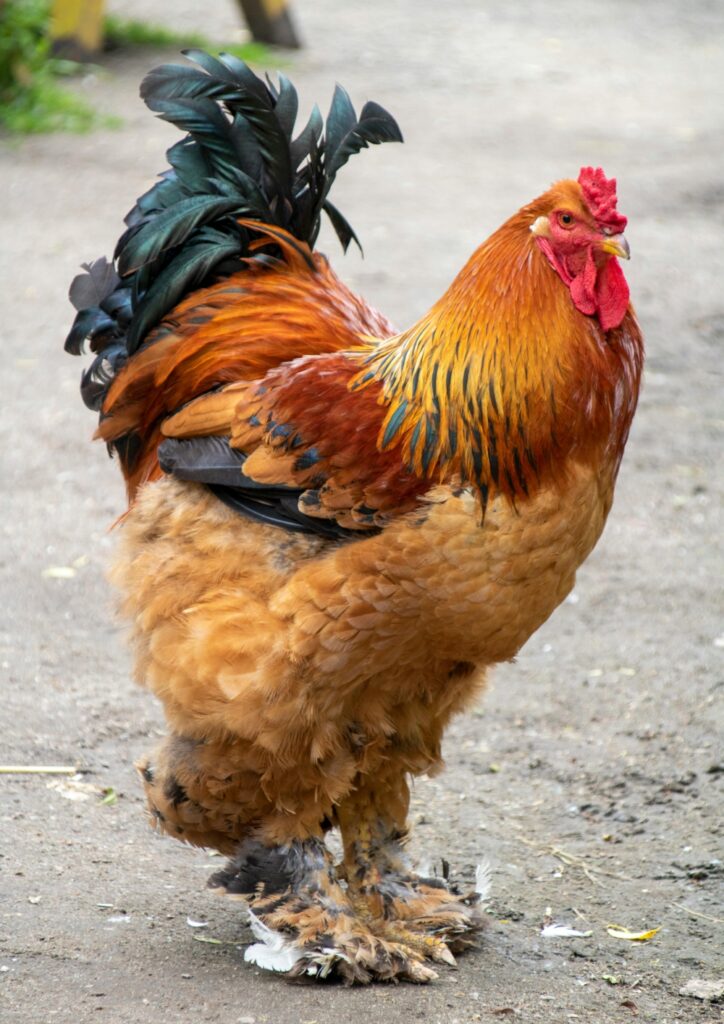
    Some breeds are suited for cooler, temperate regions,like the Brahma while others thrive in warm tropical areas.

    So, choose the appropriate breed for your climate to get the best results.

    Image of brahma chicken breed.A dual purpose breeds mainly kept in the cooler temperate regions.
    The brahma chicken breed mainly kept in the cooler temperate regions.You can see the feathers extending to her legs – They’re for protection against cold.

    8. ADAPTABILITY

    While some breeds are developed for specific regions, many can adapt and still perform well in both cold and warm areas.

    Breeds like ISA Brown, Hy-Line, and Lohmann Brown are known to do well in a wide range of conditions.

    9. DISEASE RESISTANCE

    In general, hybrids tend to have better resistance to diseases than pure breeds. This is because superior qualities are selected during their production.

    Most hybrid producers will specify the exact strengths of their birds, including the diseases they resist best. That makes it easier for you to choose.

    One Last Thing..

    Now you have a clear checklist to run through whenever a friend recommends a breed — or when you come across one online. This way, you’ll avoid making a choice you regret later.


    To help you even more, check out my recommendations for the top 3 layer chicken breeds in Kenya if you haven’t yet.

    Also register for free to get my guide plus the Layer Chicken Digest Tips via email.

    Free beginners guide to starting a profitable layer poultry farm. Step by step guide.

    See you next Friday!

    Carlos Deche

    carlosdeche4040@gmail.com

    secretlayerske@gmail.com