Tag: Secret layers

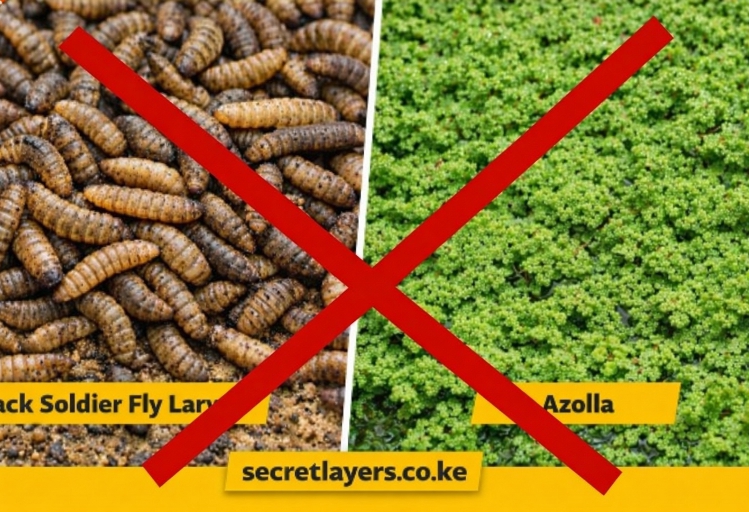
  • 5 Reasons Why I Will Never Use Azolla Or BSFL On My Farm

    Save feed costs on your poultry farm!
    Use azolla! Use black soldier fly larvae! Use hydroponic fodder!

    These are ideas you hear everywhere as creative ways of lowering poultry feed costs on your farm. In fact, azolla is the most popular of them all and has gained global attention.

    Last week, I made a post about 4 cheap poultry feed options you can use on your poultry farm.

    These feed sources promise many farmers something very attractive. Moreover, the promise is not only for poultry farmers but also for livestock farmers.

    The promise is simple.

    First, they say you will make more profits. Second, they claim you can defeat what I call the biggest monster in poultry farming — feed costs.

    However, is it really true? Do these cheap poultry feed alternatives really increase profits the way marketers claim?

    Meanwhile, businesses have been built around azolla and black soldier fly larvae poultry feed (BSFL). Some entrepreneurs even produce tonnes of BSFL every week.

    In addition, influencers have built entire online brands around azolla farming.

    Therefore the real question becomes this:
    Are these alternative poultry feeds truly helpful, or are they just another gimmick that keeps farmers stuck in the same vicious cycle?

    In this blog post, I will give you five reasons why I would never use alternative poultry feeds on my farm.

    However, there is one condition where I would use them. Keep reading to find out.
    1. They Are For Small Farms

    You have a 10,000 layer chicken farm. Alternatively, imagine running a 100-cow dairy farm.

    Would you consider using black soldier fly larvae poultry feed for your chickens?
    Or would you consider using azolla as cattle feed supplement?

    Maybe you said yes. And honestly, I respect that.

    However, I would not.

    Think about the scale for a moment.

    How many tonnes of BSFL would you need for the chickens? Likewise, how many tonnes of azolla would your cows require?


    To make it worse, how many truckloads of garden or kitchen remains would you need to produce that amount?

    The truth is simple. Most alternative poultry feeds work very well for small farms.

    For example, if you have 500 chickens, azolla and BSFL can significantly reduce your poultry feed costs.

    However, these options become almost useless for large-scale farmers like in the examples above.

    A good example is Dr. Daniel Masaba, one of the most successful layer farmers in Uganda. He once tried using azolla and BSFL to reduce feed costs on his farm.

    However, he later abandoned the idea.
    In one of his videos, he explained that the system was not feasible for a large-scale poultry farm.
    At that time, he had around 7,500 layers.

    The reason is clear. The amount of production required to feed a large flock becomes massive.

    Therefore, without serious infrastructure and capital, producing your own alternative poultry feeds can become more expensive than simply buying commercial poultry feed.

    2. They Are Not Nutritionally Sufficient

    Another problem is that alternative poultry feeds are not replacements for commercial poultry feed.
    Instead, they act as supplements.

    In other words, they are similar to the vitamins and minerals farmers add to feed. However, in this case, you must use larger quantities.

    That is where the problem starts.


    Yes, these feeds may reduce costs. However, by how much?
    Certainly not 50%.

    By the way, tell me in the comments: what percentage of feed costs do you think azolla or BSFL actually reduce?

    Interestingly, many farmers cannot even say exactly how much money they are saving.

    Meanwhile, if azolla, BSFL, and hydroponic fodder could completely replace commercial feed, I would be among the first people to use them.

    Why?
    Because feed prices are brutal right now. Every poultry farmer knows that feed costs are killing profits.

    But the reality is different.
    Even after preparing these alternative feeds, farmers still have to buy commercial poultry feed.

    Therefore the farmer does extra work while still paying the same major cost.
    For me, that is still a tough game.

    3. You Cannot Measure The Nutrients

    Layer chickens and broilers both require very specific nutrition at different stages of growth.

    For example, growing layers need higher protein levels. Later, laying hens require higher calcium levels for strong eggshells.

    Fortunately, commercial feed companies calculate these values very carefully.

    As a result, each bag of poultry feed contains balanced levels of:

    -Protein

    -Energy

    -Calcium

    -Vitamins

    -Minerals

    Because of this system, guessing is removed and errors are very unlikely.

    However, the same cannot be said for most alternative poultry feeds.

    Standard nutrient estimates exist for azolla and BSFL. Unfortunately, those numbers may not match what you actually produce.

    For example, how much protein is in your azolla pond today?

    Even worse, how much protein is in your leftover cabbage or kitchen remains?

    Honestly, you cannot know unless you send the sample to a laboratory.
    As a result, birds may receive insufficient poultry nutrition.

    Eventually, that problem begins to show in production.

    You may start seeing:

    -Fewer eggs

    -Small egg size

    -Weak eggshells

    Sadly, many farmers blame the feed company.
    Meanwhile, the real cause might be the alternative poultry feeds being used.

    4. They Are Hard To Produce Consistently

    Personally, I like simple systems most of the time.

    If you also like simple systems, I created a Free ebook for you.

    It is a guide for starting and running a profitable layer poultry farm.
    Free beginners guide to starting a profitable layer poultry farm. Step by Step guide.
    Name
    Limited access. Join other serious farmers who have taken the guide and get support.

    Gey your copy Now!

    Now let’s compare the effort involved.

    Compared to producing your own formulated poultry feed, raising azolla or BSFL may seem easier.

    However, compare those systems to simply buying ready-made commercial poultry feed.

    In that situation, I would still choose commercial feed.

    The reason is consistency.

    Producing alternative poultry feeds correctly requires several steps:

    -Proper preparation

    -Understanding the nutrient composition

    -Formulating correct feed ratios

    -Maintaining the system daily

    In addition, farmers must do this every single day to keep results stable.
    Therefore the system becomes harder than simply purchasing high-quality poultry feed.

    However, if the benefits clearly outweigh the extra effort, then the work may be worth it.

    Ultimately, that decision becomes a personal choice for each farmer.

    5. Health Risks To Your Chicken

    Imagine trying to reduce feed costs and accidentally killing your chickens.

    That situation would be a farmer’s worst nightmare.

    Fortunately, reported cases of problems from alternative poultry feeds are rare.

    However, rare does not mean impossible.

    Commercial poultry feeds are usually processed under controlled conditions. In addition, they often contain coccidiostats and quality controls.

    Meanwhile, homemade feed systems can introduce new risks.


    For example, kitchen remains might already be decomposing, food remains may contain spices or substances harmful to poultry.

    Azolla can also become dangerous if it grows in dirty or contaminated water.
    Poor storage can also lead to spoilage or fungal growth.

    Meanwhile, black soldier fly larvae can transmit disease if they are reared or stored in unsanitary conditions.
    Although such problems are uncommon, they are still possible.

    Unfortunately, farmers may not even realize that the alternative poultry feed is the real cause of illness in their birds.

    When Would I Use Azolla Or BSFL?

    Those are the five reasons I would not use alternative poultry feeds on my farm.

    However, there is one situation where I might use them.

    That situation is simple.

    I would consider them only if I planned to run a small farm.

    However, that is not my plan.

    In fact, the book I am currently writing contains a full chapter called “Before You Start Your Farm.”

    One key idea in that chapter is this:
    Think big. Build big.

    That message is also central to the Secret Layers community.


    Earlier, I published a post about five powerful solutions to high animal feed costs.

    In that article, my first solution was simple:
    Go big.

    Large-scale farms benefit from economies of scale, better systems, and stronger profit margins.

    Therefore my advice is clear.
    Do not think small.
    Do not stay small.
    Most importantly, do not fall into the trap of farming trends that do not scale.


    See you next Friday!

    secretlayerske@gmail.com
    carlosdeche4040@gmail.com
  • Should You Really Vaccinate Your Chicken? The Truth!

    Should you vaccinate your chicken or not?

    That question has been debated for many years among poultry farmers.
    Although many people think the answer is obvious, the reality on the ground tells a different story.


    Before we go further, let me ask you something.

    Did you get the COVID-19 vaccine?

    If you did, did you complete all the doses?

    As of late 2024, about 70% of the global population received at least one COVID-19 vaccine dose. However, in many low-income countries like Kenya, only about 38.9% received even the first dose.

    Therefore, vaccine hesitancy is not just a chicken problem. It is a human problem too.

    For the record, I received my full COVID-19 vaccination.

    Because I am in my final year of medical school at the University of Nairobi, I understand how vaccines work in both humans and animals.

    Now, let us apply those same principles to poultry farming.


    In this article, I will:

    Explain how vaccines work.


    Address common concerns about chicken vaccination.


    Give five clear reasons why you should vaccinate your chickens.


    Share practical tips to avoid costly mistakes.


    Ultimately, the final decision is yours. However, I encourage you to read carefully so you can protect your birds, your customers, and your profits.

    How Do Vaccines Work?

    Let me simplify how vaccines work.

    Normally, when a disease attacks a chicken, the body produces “soldiers” (antibodies) to fight the virus, bacteria, or parasite. If the chicken’s immunity is strong, those soldiers destroy the disease before serious signs appear.

    However, when immunity is weak, the disease multiplies. As a result, the chicken becomes sick and may die.

    Fortunately, when a chicken survives an infection, the body keeps memory cells. Because of that memory, the body can respond faster if the same disease attacks again.


    So how does a vaccine help?

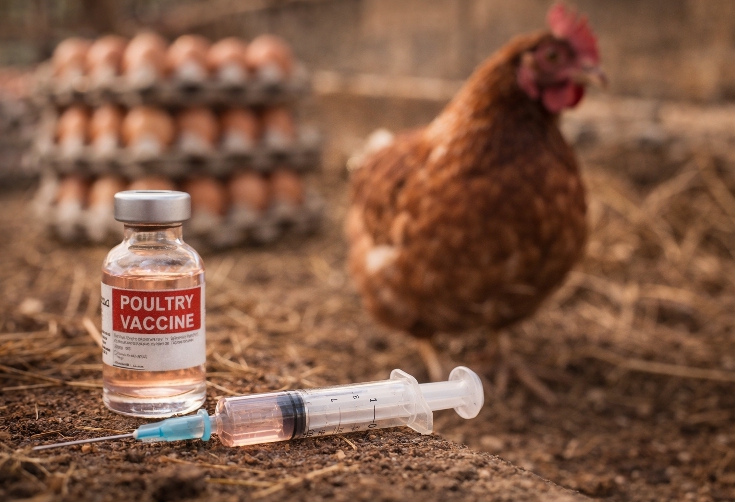
    Simply put, a vaccine contains a weakened or killed form of a disease. When you give it to a healthy bird, the body produces soldiers without causing full disease.

    Later, if Newcastle disease, Gumboro (Infectious Bursal Disease), Fowl Pox, or Infectious Bronchitis attacks, the bird is already prepared.

    Consequently, the immune system responds quickly and strongly.
    That is the basic science behind chicken vaccination.

    Layer Chicken Vaccination
    Despite what you might have heard, vaccinating your chicken is more beneficial than harmful and honestly, a MUST.

    5 Common Concerns About Poultry Vaccination

    Although vaccines are widely used in layer poultry farming in Kenya, many farmers still have concerns.

    Let us address them honestly.

    1. Vaccines Make Birds Sick And Kill Them

    Yes, vaccines can cause mild reactions. However, serious death from vaccines is rare when birds are healthy.

    In most cases, problems happen because:

    The birds were already sick.

    The wrong dosage was used.

    The vaccine was poorly stored.

    Biosecurity was weak.


    Therefore, proper poultry biosecurity and correct handling are critical.

    2. Vaccines Do Not Work

    It is true that vaccines are not 100% effective. However, no medical intervention in the world is 100%.

    Even so, vaccinated flocks have much lower mortality during outbreaks of Newcastle disease or Gumboro compared to unvaccinated flocks.

    In other words, vaccination reduces risk. It does not eliminate risk completely.

    3. Vaccines Contaminate Eggs And Meat

    Some farmers worry that vaccines remain in the chicken’s body and make eggs unsafe to eat.

    However, approved poultry vaccines are tested for safety. Most do not remain in meat or eggs in harmful amounts when used correctly.

    In fact, vaccination often improves food safety by reducing diseases like Salmonella that can contaminate eggs.Therefore, following proper dosage and observing recommended guidelines ensures both bird health and consumer safety.

    4. Vaccines Are Expensive

    Some farmers believe chicken vaccination increases production costs.
     
    At first glance, that concern makes sense because every input on a poultry farm affects profit.However, vaccines usually make up a very small percentage of total farm costs.
     
    In most layer poultry farms in Kenya, vaccination costs are only a small fraction of feed, housing, and labor expenses.
     
    Therefore, the real question is not “Are vaccines expensive?”
     
    Instead, the better question is, “Compared to what?”
     
    Because disease outbreaks like Newcastle disease or Gumboro can wipe out an entire flock, skipping vaccination is often the more expensive decision in the long run.
    We will look at the actual numbers shortly.

    5. Conspiracy Theories

    Some people say vaccines are brought to kill our birds so that large companies control the egg market.
     
    Others claim vaccines are just a money-making scheme.
     
    However, these simply lack evidence and cannot be supported.

    So, Should You Vaccinate Your Chicken?

    Yes.
    Here are five practical reasons:

    Get this Free Layer Poultry Farming Ebook straight to your inbox if you want to start a profitable farm:

    Free beginners guide to starting a profitable layer poultry farm. Step by Step guide.
    Name
    Limited access. Join other serious farmers who have taken the guide and get support.

    1. To Prevent Disease

    Vaccines were created to prevent disease before it destroys lives or flocks.
     
    For example, vaccination helped eliminate polio in humans and reduce tetanus worldwide.
     
    Similarly, using a proper chicken vaccination schedule protects your birds from deadly poultry diseases.

    2. To Reduce Mortality

    When your birds are protected, fewer die during outbreaks. Meanwhile, unvaccinated farms suffer heavy losses.
     
    Imagine an outbreak of Infectious Bronchitis in your area. In that situation, vaccinated birds are far more likely to survive than the unvaccinated flocks.

    3. Herd Immunity

    When most birds in a flock are vaccinated, disease spreads more slowly. As a result, even birds that missed vaccination may have some protection.
     
    Nevertheless, you should always aim to vaccinate the entire flock properly.

    4. Better Quality Produce

    Food safety matters.
    Although salmonella contamination is a known global problem, proper vaccination and good hygiene reduce the risk significantly.
     
    In fact, some egg buyers and large distributors require proof of a proper chicken vaccination schedule before purchasing eggs.
     
    Therefore, vaccination supports both public health and market access.

    5. To Save And Make Money

    Every poultry farmer is in business to make profit.

    Because disease reduces egg production, increases mortality, and raises treatment costs, it directly eats into your income. Vaccination protects your cash flow.

    Let us look at the numbers..

    Ksh 5,000 for vaccines or Ksh 200,000 loss from total flock death.

    Ksh 5,000 for vaccines or Ksh 50,000 spent on treatment.

    Ksh 5,000 investment or Ksh 500,000 lost egg income over two years.

    Clearly, this is not just about disease prevention. It is about protecting your business.

    As the saying goes, if education is expensive, try ignorance.

    Likewise, if vaccines seem expensive, try treating Newcastle.

    Practical Tips For Vaccinating Your Chicken

    First, remember that proper biosecurity is your strongest protection.

    Second, consult a local poultry vet about common diseases in your area.
     
    Third, vaccinate birds before they get sick. Vaccines prevent disease; they do not cure it.
     
    Finally, get a clear vaccination schedule from a reputable day-old chick supplier.

    Now You Have The Facts

    At this point, the decision is yours.
     
    However, if you are serious about layer poultry farming in Kenya, protecting your flock should be a priority.
     
    So ask yourself again: Should you vaccinate your chicken?
     
    If your goal is healthy birds, safe eggs, and steady profits, the answer is clear.
     
    If you found this helpful, read my detailed guide on the best layer chicken vaccination schedule for layers to choose the one that fits your farm.

    See you next Friday!

    carlosdeche4040@gmail.com

    secretlayerske@gmail.com

  • How Online MarketPlaces Can Save Farmers From Middlemen


    Let me tell you my story. I’m from Tezo, Kilifi County, about 10 km from Kilifi town. Sometimes, I buy one tomato for Ksh.10. On the best days, I’ve bought a single tomato for just Ksh.5.


    For someone who doesn’t know the supply chain for agricultural produce, that may seem normal. However, a deeper look—or just a quick search on Google—reveals the truth. It’s shocking and a little terrifying.


    In 2024, tomato prices in Kirinyaga dropped to Ksh.15 per kilogram. When a farmer sells that kilo for Ksh.15 to a middleman, the price in Kilifi jumps to around Ksh.70–100 per kilogram. That is a huge difference, and it shows how much profit is being captured by middlemen instead of the farmers who grew the tomatoes.


    Imagine if I could check online and see a farmer in Kirinyaga selling tomatoes for Ksh.40 per kilogram. I would buy immediately. I would pay Ksh.30–50 less. At the same time, the farmer would earn Ksh.25 more, which is a 167% increase. This kind of win-win situation is exactly what online marketplaces could make possible.


    It’s not as simple as it sounds. Many farmers in Kenya already use social media like WhatsApp, Facebook, Instagram, and TikTok to sell their produce. It works for some, but there are challenges that make it hard to scale and provide real value for both farmers and consumers.


    Today, let’s focus on farmers online marketplaces, like Mkulima Young, Mkulima Bora, and Mkulima Online. These are different from social media platforms.

    What Can They Do To Help Me Buy 2 kg Of Tomatoes From Kilifi At A Fair Price While Also Ensuring That Farmers Earn More?

    1. Logistics


    Farmers often cannot sell to all individual buyers across the country because transporting small amounts of produce is expensive. If they try to deliver on their own, the cost may wipe out their profits. Middlemen solve this problem by collecting from many farmers and delivering to consumers, but they usually pay farmers very low prices.


    Online marketplaces need a reliable logistics system to solve this problem. They can either build their own delivery network or partner with delivery companies. By solving this hurdle, marketplaces can help farmers sell at fair prices while making sure consumers still pay less than they would at the market.

    2. Trust


    Trust is one of the biggest challenges. No buyer wants to pay for goods that never arrive, and no farmer wants to deliver produce without being paid. Many online platforms in Kenya struggle because buyers and farmers are unsure whether the other party can be trusted.


    Even though M-Pesa exists for safe payments, many buyers prefer to negotiate on WhatsApp. People feel more control and security when they can see and communicate directly with the seller. Platforms like Jumia show that trust can be built over time with consistent service and marketing, but it takes years and a big budget to convince buyers to feel safe using a platform.

    3. Business Model


    Another important challenge is the business model itself. Should online marketplaces sell directly to consumers or focus on mama mbogas? A B2B (business-to-business) model could actually be more effective.


    In this approach, farmers sell at higher prices to the platform. The platform then sells to mama mbogas at lower prices than the middleman would charge. Finally, consumers get fresh produce at lower prices from the mama mbogas. This system ensures that everyone benefits: farmers earn more, mama mbogas pay less, and consumers get better prices.


    Twiga Foods uses a similar model. They buy produce directly from farmers at fair prices and supply mama mbogas reliably. Even though they act like a large middleman, they are more predictable and less exploitative. Online marketplaces could adopt this strategy to create a fairer agricultural supply chain.

    What Next?


    Farmers online marketplaces can succeed if they solve logistics, trust, and business model challenges. Platforms that address these issues will empower farmers, reduce middlemen exploitation, and make fresh produce more affordable for consumers. In the future, these marketplaces could even help farmers export produce across Africa and the world.


    Do you think online marketplaces can really help farmers escape middlemen?

    I’d love to hear your thoughts in the comments.

    Follow my YouTube channel to learn more about how you can start and run a profitable layer poultry farm👇🏿

    https://youtube.com/@secretlayerske?si=nYnAL-jwN6Wc3PlV

    See you next Friday!

    carlosdeche4040@gmail.com

    secretlayerske@gmail.com

  • 9 Common Layer Chicken Diseases And How To Recognize Them Early

    Diseases in layers can reduce egg production, slow growth, and even kill birds if a farmer does not act early.

    Many problems start with small signs, so it helps to know what to watch for.


    First, always observe your birds every day. Early action saves money and protects the flock.

    These are the common chicken diseases in layers,how to recognize them early and how to treat them.

    1. Marek’s Disease

    Marek’s disease is a viral disease caused by a herpes virus. It spreads when birds inhale infected dust or feathers.

    Signs to look for:

    Paralysis of one leg or both legs.

    Incoordination

    Drooping wings or neck.

    Weight loss and poor appetite.

    Rough feathers .

    Depression.

    Tumors or swellings.

    Drop in egg production.


    Prevention is by vaccination at an early age.

    Mainly given on day one at the hatchery if you buy from reputable hatcheries.

    2. Infectious Bursal Disease (Gumboro)

    This disease is caused by the IBD virus. It weakens the immune system, so birds get sick easily.

    Signs to look for:

    Watery diarrhea.

    Wet and soiled feathers.

    Poor feeding.

    Ruffled feathers.

    Weakness and incoordination.


    Vaccination is the best prevention.

    3. Coccidiosis

    Coccidiosis is a protozoal disease that affects the gut. Birds get it by eating oocysts from contaminated litter or soil.

    Signs to look for:

    Bloody or mucoid diarrhea.

    Low feed intake and weight loss.

    Dehydration.

    Pale comb and wattles.

    Drop in egg production.

    It is usually self limiting – meaning it goes away without treatment so long as the birds are healthy.


    Wet litter increases risk because it helps the parasite multiply.

    Treatment is with anticoccidial drugs, and sometimes antibiotics are used to control secondary infections.

    4. New Castle Disease

    Newcastle disease is a highly contagious viral disease.

    It affects the nerves, breathing system, and egg production.

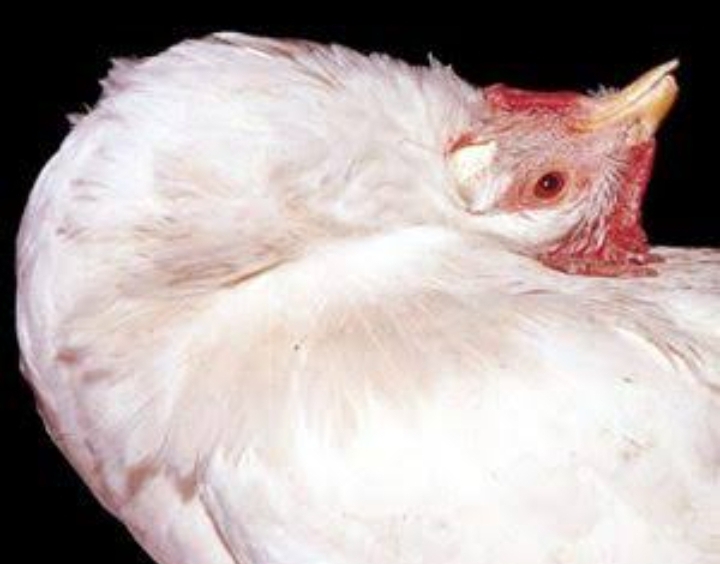
    Neck twisting. Common in New Castle Disease. In a secret layers blog post of 9 Common layer chicken diseases.
    Neck twisting in a chicken. Commonly seen in New Castle’s Disease.

    Signs to look for:

    Twisted neck and circling.

    Wing drooping and paralysis.

    Tremors.

    Sneezing and coughing.

    Greenish diarrhea.

    Soft or deformed eggs.

    Sharp drop in egg production.

    Vaccination is essential for prevention.

    5. Infectious Coryza

    Infectious coryza is a bacterial respiratory disease. It spreads quickly in a flock.

    Signs to look for:

    Facial swelling around the eyes and cheeks.

    Thick, bad-smelling discharge from eyes or nose.

    Noisy breathing or open-mouth breathing.

    Poor appetite.

    Pale combs and wattles.

    Drop in egg production.


    Treatment is with antibiotics and good hygiene.

    6. Fowl Pox

    Fowl pox is a viral disease caused by the avian Pox virus.

    It has two forms:

    Dry Form/Cutaneous

    Scabs or lesions on comb, wattles, and legs.

    Wet Form/Diphtheric

    The wet form is more serious because:

    Lesions form in the mouth and throat.

    Birds have trouble breathing or swallowing.

    Feeding decreases and production drops.


    Vaccination helps prevent this disease.

    7. Infectious Bronchitis

    Infectious bronchitis is another viral respiratory disease.

    Signs to look for:

    Coughing and sneezing.

    Nasal discharge.

    Gasping and breathing sounds.

    Wrinkled or poor-quality eggs.

    Reduced egg production.

    Facial swelling.

    Vaccination and good ventilation help control it.

    8. Worm Infestation

    Worms are internal parasites that affect growth and production.

    Signs to look for:

    Weight loss.

    Diarrhea, sometimes with worms.

    Pale comb and wattles.

    Low egg production.

    Lethargy.

    Regular deworming helps prevent heavy infestation.

    9. Fowl Typhoid

    Fowl typhoid is a bacterial disease that can cause heavy losses.

    Signs to look for

    White diarrhea stuck on feathers.

    Poor feeding and weight loss.

    Weakness and ruffled feathers.

    Pale comb and wattles.

    Reduced egg production.

    Treatment is with antibiotics and strict hygiene.

    Which of these diseases has been disturbing you on your farm?

    Let me know in the comments.

    Treatment Principles

    When disease appears, act quickly.

    First, isolate sick birds to stop spread.

    Next, provide clean water and good feed to support recovery.

    Finally, use vaccination, antibiotics, or other drugs only when appropriate and based on the disease.

    Consult your local veterinary.

    Vaccination Schedule

    After a long period of struggling with the proper vaccination schedule to use for my layers, I researched and found the best one.

    One simple schedule and the Kenchic one.

    Read here to know which is best for your farm👇🏿

    https://secretlayers.co.ke/blog/vaccination-schedule-for-layers-a-simple-guide-for-farmers/

    If you’re yet to start your layer poultry farm, get this Free guide to help you start.

    Name
    Limited access. Join other serious farmers who have taken the guide and get support.

    See you next Friday!

    carlosdeche4040@gmail.com

    secretlayerske@gmail.com