Some lessons hit you in ways you never forget—this one came from chickens.
When I was growing up, I spent a lot of time around poultry farms. One morning, my dad decided to take us to see how different types of chicken farms operate.
We arrived at the broiler farm just as the sun was rising. The air was thick with the smell of feed and the soft hum of ventilation fans. Workers moved quickly, carrying the chickens from their pens toward the processing area. The birds scattered and squawked, jostling against one another. You could almost feel their fear—they knew what was coming. My dad led us aside before we saw anything more, but the lesson was already clear: these birds were being raised for a single, final payoff. Everything on the farm was geared toward one moment—the sale.
A few days later, my dad took us to a layer farm. The difference hit me immediately. The hens moved calmly, pecking at the feed, scratching the ground, and laying eggs day after day. The barn was quieter, the atmosphere almost peaceful. The farmer collected the eggs as they came, creating a steady, predictable flow of income. Unlike the broiler farm, success here didn’t depend on selling the birds—it depended on the output they produced consistently.
Layer Chicken in a poultry house.
My dad stopped and looked at me. “See the difference?” he asked. Both farms own valuable assets—the chickens—but they treat them in completely different ways.
The broiler farmer is like an investor chasing capital gains: the money comes only at the end, when the asset is sold.
The layer farmer is like an investor chasing cash flow: the asset produces money day after day, steadily and reliably.
Most people invest like broiler farmers—they wait for a single big payout and call it risky. The wiser approach is to think like the layer farmer and be the layer farmer: focus on cash flow, let your assets work for you every day, and build wealth steadily.
This is a fictional story inspired by the story of the cattle rancher and dairy farmer in Robert Kiyosaki’s book : Who Took My Money? Why Slow Investors Lose And Fast Money Wins.
Ludwig Wittgenstein “The limits of my language mean the limits of my world.”
You can’t operate expertly in a field if you don’t understand the words that define it. This is everything you should know about layer chicken, layer poultry farming and the business of layers. The list will be updated every week with new information. Please learn. Layers – Adult hens raised primarily for egg production. In layer poultry farming, layers are the backbone of your egg business, providing consistent daily eggs once they reach maturity.
Pullets – Young female chickens, usually under 20 weeks old, that have not yet started laying eggs. Pullets are the future layers of your flock.
Day-Old Chicks (DOCs) – Newly hatched chicks, only a day old. Farmers buy day-old chicks to rear them into pullets or point-of-lay birds for egg production.
Point of Lay (POL) – Birds that are about 16–20 weeks old and ready to start laying eggs. Point-of-lay hens are ideal for farmers who want to begin egg production quickly.
Feeder – A container or tray used to provide feed to your birds. Using the right feeder in layer poultry farming ensures minimal feed wastage and healthy growth.
Drinker – Equipment that supplies clean water to chickens. Proper drinkers are crucial for layers’ health and optimal egg production.
Brooding – The process of keeping chicks warm, usually with a heat source, during their first few weeks. Brooding is critical to prevent chick mortality.
Incubator – A machine used to hatch eggs artificially by maintaining the right temperature and humidity. Incubators allow farmers to hatch chicks without using a broody hen.
Mortality – The number of birds that die within a flock over a given period. Low mortality rates indicate good management in layer poultry farming.
Layer Mash – A balanced feed specially formulated for laying hens to maximize egg production and quality. Layer mash provides the nutrients needed for strong shells and healthy layers.
Bird – A general term for chickens, hens, or roosters in your flock. In layer poultry farming, the term usually refers to your egg-laying hens.
Feed to Egg Conversion Ratio (FCR) – A measure of how efficiently a layer converts feed into eggs. Lower FCR means better efficiency and higher profitability.
Ex-Layers / Spent Layers – Hens that have completed their peak laying period and are no longer productive. Farmers often sell them for meat or dispose of them responsibly.
Debeaking – A management practice where part of a chicken’s beak is trimmed to prevent feather pecking or cannibalism. Debeaking helps protect your flock in crowded layer farms.
Culling – The process of removing weak, sick, or unproductive birds from the flock. Culling ensures only healthy layers remain for maximum egg production.
Litter – Bedding material, like wood shavings or straw, used on the poultry house floor. Proper litter management keeps your birds healthy and reduces disease risk.
Cages – Enclosures used to house layers, especially in commercial layer poultry farming. Cage systems help manage feed, water, and egg collection efficiently.
Newcastle Disease – A highly contagious viral disease that affects chickens, causing respiratory issues and high mortality. Vaccination is critical to protect your flock.
Infectious Bronchitis (IB) – A viral disease in poultry that affects the respiratory system and egg production. Proper biosecurity and vaccination reduce the risk.
Marek’s Disease – A viral disease in chickens that causes tumors and paralysis. Vaccinating day-old chicks helps prevent Marek’s in your flock.
Deworming – The process of giving chickens medication to remove internal parasites. Regular deworming keeps your layers healthy and improves feed-to-egg efficiency.
Gumboro (Infectious Bursal Disease– A viral disease affecting young chickens, weakening their immune system. Vaccination protects your flock and supports healthy layer development.
Starter Mash – A high-protein feed for day-old chicks to ensure healthy growth in the first few weeks. Starter mash is the foundation for strong pullets.
Grower Mash – Feed given to pullets after the starter stage but before they begin laying eggs. Grower mash ensures proper growth and readiness for point-of-lay.
Free Range – A system where chickens can roam outdoors for part of the day. Free-range layers often produce healthier eggs and can command a premium price.
Pasture Raised – Chickens raised primarily outdoors on pasture with access to insects and grasses. Pasture-raised layers provide high-quality, nutrient-rich eggs and enjoy better welfare.
You’ve decided to go into poultry farming, but now you’re stuck between layers and broilers, unsure of their differences.
You don’t want to invest your hard-earned money blindly and fail because of limited information. That would be costly ignorance. The choice you make—whether to keep layers or broilers—will influence your time involvement, the costs you incur to start and manage your poultry farm, your profitability, and ultimately your happiness as a farmer.
This guide aims to remove confusion by explaining 10 key differences between layers and broilers and adding a profitability score for both. Make the right choice for your poultry farm.
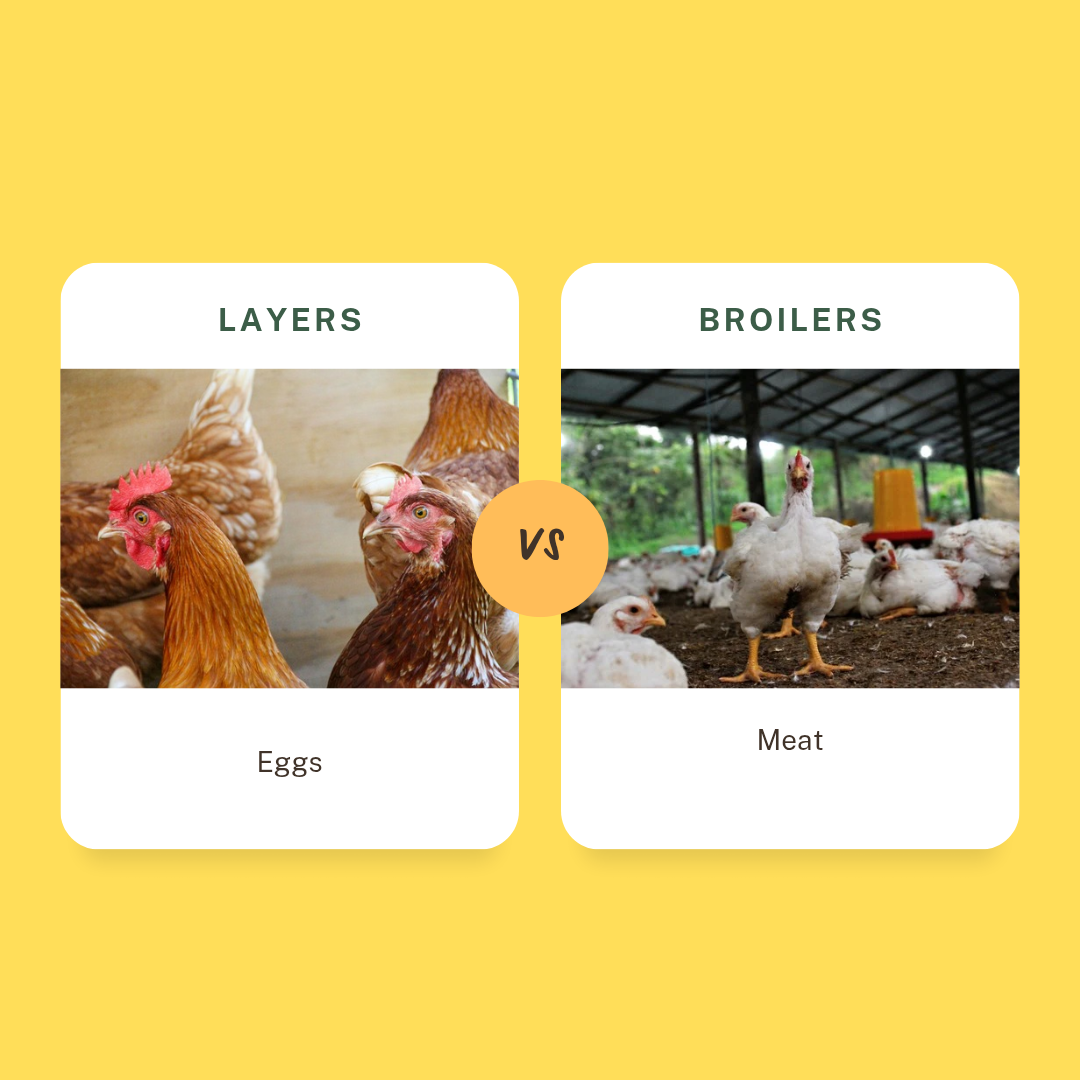
Layer vs broiler chicken side by side – see the physical differences clearly.
What Are Layer Chickens vs Broiler Chickens? Before diving into differences, let’s define these two types of poultry. Broilers – Chickens bred and raised primarily for meat production. Layers – Chickens kept mainly for egg production.
Here’s a quick Layers vs Broilers comparison.More details below:
Feature
Layers
Broilers
Main Purpose
Eggs
Meat
Startup Costs
Higher
Lower
Time to harvest
Start laying at 18 weeks
Ready for sale 6-9 weeks
Market Stability
Stable demand
Demand fluctuates
Housing System
Battery cage or deep litter
Mostly deep litter
Vaccine Schedule
Longer
Shorter
Spacing
Bigger(2-3sq ft/bird)
Smaller(1-2 sq ft/bird)
Feeds
Starter Grower Layer
Starter Finisher
Profit Type
Daily income Continuous
Quick One time batch
Management Level
More skilled Long term
Easier Short term
Lighting
Less 14-18 hrs
More 24 hrs
Profitability Score
8.3
7.5 (Check below for how it was compiled)
(Layers vs broilers differences table) With that in mind, here are the 10 key differences in details. 1. Startup Costs Startup costs for layers are significantly higher compared to broilers.
This is because layers require more housing space, higher-priced chicks, a longer vaccination program, and more feed in their early months. For example, in Kenya in 2025, starting with 100 broilers costs approximately KSh 100,000, whereas 100 layers could cost upwards of KSh 300,000.
These figures are estimates and can vary based on region, type of housing, and market fluctuations. (Tip: I’ll soon publish a full, accurate cost breakdown for starting a layer poultry farm.)
2. Time Commitment Layers require more time and commitment than broilers.
While broilers are typically raised for a short period—6 to 9 weeks before slaughter—layers stay on the farm for up to 2 years as long as they remain productive. Because layers stay longer, they need continuous care, including vaccination follow-ups, debeaking, egg collection, and regular health monitoring.
Broilers, on the other hand, have a shorter but more intensive cycle, allowing you to free up your time after each batch. 3. Market Dynamics The market for eggs is generally more stable than for broiler meat.
In Kenya, there are significantly more broiler farmers than layer farmers, which means meat supply often outpaces demand. This can lead to price drops during peak seasons. Eggs, however, have a steady demand from institutions, hotels, retail shops, and households.
Even better,layers give you more time to plan because they start laying at about 18 weeks (4.5 months), whereas broilers must be sold within 6 weeks. That short sales window for broilers means you should find your market before buying your chicks. 4. Housing Systems Layers can be raised in both battery cages and deep litter systems, providing flexibility depending on your budget and management style. Broilers, however, are mostly raised on deep litter systems only. Imagine broilers in cages—uncommon and impractical due to their rapid growth and space requirements. If you want options for expansion or automation, layers offer more choices.
Get detailed guides on layer chicken here 5. Vaccination Programs Because layers live longer, their vaccination schedule is more extensive.
Vaccines for layers typically include Marek’s, Newcastle, Infectious Bronchitis, Gumboro, Fowl Pox, and periodic deworming. Broilers, on the other hand, have shorter lifespans and need fewer vaccines—mainly Marek’s, Newcastle, and Infectious Bronchitis.
This makes broilers easier and cheaper to manage from a health perspective, especially for beginners. 6. Space Requirements Layers need more space per bird compared to broilers.
They are active, long-lived, and require at least 2–3 square feet per bird. Broilers, by comparison, only need about 1–2 square feet per bird. This difference directly affects your housing investment. A larger poultry house for layers means higher construction costs upfront. If your available space is limited, broilers might be easier to start with. 7. Feed and Nutrition Feeding layers is more expensive in the long run because they go through multiple feed stages—starter, growers mash, and layers mash.
Additionally, their feed must be rich in calcium and other minerals to support eggshell production, while protein levels stay moderate (16–18%). Broilers only need starter and finisher feeds, formulated with high protein levels (around 23%) to promote fast muscle growth. Because their cycle is short, their total feed cost per cycle is often lower, making broilers appealing for quick-turnaround ventures.
Find more details on broilers best practices here 8. Profitability Potential Both layers and broilers can be profitable, but the pattern of profitability differs.
Broilers deliver quick, one-time profits per batch, ideal if you want fast cash flow.
Layers, however, offer stable long-term income through daily egg sales once production starts. Layers often have a higher profit margin because you buy birds once and earn from them continuously for about 22 months.
Broilers require you to restock every 6 weeks, which can be labor-intensive but gives multiple opportunities to adjust market strategy. 9. Management Skills Required Managing layers is more demanding than managing broilers.
Layers need specialized skills, including handling vaccinations, debeaking, egg collection, and monitoring productivity over a long period. However, once your layers are established, you don’t need to buy new birds for almost two years. Broilers are simpler in terms of management but require high attention during their short growth period. They need constant monitoring for weight gain, proper feeding, and quick marketing decisions. 10. Lighting Requirements Lighting needs also differ significantly. Layers require controlled lighting, typically 14–18 hours daily, to maintain egg production. Broilers, however, need near-constant lighting (24 hours) to encourage continuous feeding and rapid weight gain. This difference impacts your power costs and infrastructure decisions.
ProfitabilityScore
Criteria
Layers (Score 1-10)
Broilers (Score 1-10)
Startup Costs
6 (Higher but worth it)
8 (Lower)
Time to returns
7 (Slower)
9 (Fast)
Profit Stability
10 (Very stable)
6 (Seasonal
Market Demand
10 (Strong & Steady)
7 (Fluctuating)
Management Complexity
7 (Challenging but rewarding
8 (Simpler)
Long Term Profit
10 (Excellent)
7 (Moderate)
Average Score
8.3
7.5
(Layers vs broilers differences in profitability)
Layers have it🥳
If you’ve already decided it’s layers, I have a step by step guide on how to start your layer chicken farm the right way here
And to start you off,
Enter your details to grab a copy of my free printable guide and regular Layer Chicken Digest tips via email:
Which Option Carries More Risk? Risk depends on your resources and experience.
Layers require more startup capital, long-term commitment, and skilled management, but they also provide steady income after maturity. You won’t see returns until after 4.5 months when they start laying, so patience is necessary. Broilers carry a different risk. Their short cycle means that if you fail to secure a market quickly, your birds continue eating expensive feed while gaining weight beyond market standards.
Unfortunately, most buyers won’t pay extra for heavier birds, leaving you with slimmer profit margins—or even losses.
Which Should You Choose? The decision between broilers and layers depends entirely on your goals.
If you prefer long-term, stable income and are willing to invest more time and capital upfront, layers are ideal. If you want quick turnover and have a reliable meat market, broilers may suit you better. Think about your financial resources, available space, time commitment, skill level, and long-term vision. Choose what aligns with your goals, even imagining what you’d be comfortable managing for the next decade—eggs or meat? Common Questions Beginner Farmers Ask 1. Can you keep both layers and broilers together? Yes, you can keep both on the same farm, but never in the same house. Maintain two separate poultry houses at a safe distance to prevent disease transmission. 2. Layers vs broilers—Which is Better? There’s no universal answer. The better choice is the one that matches your current financial position, skill level, and business goal. Carefully weigh startup costs, time involvement, and market potential before deciding. 3. Which is best for small farms? For small farms with limited capital, broilers are often the better starting point because of lower upfront costs and faster returns. Finally, The layers vs broilers differences go beyond just eggs versus meat. They influence your time, money, and long-term profitability. Understand your goals clearly and then choose the option that matches your situation. If you want to explore layers further, check out for my upcoming detailed guide on the cost of starting a layer poultry farm. It will include cost by cost breakdown and projected revenue and profits.