Save feed costs on your poultry farm!
Use azolla! Use black soldier fly larvae! Use hydroponic fodder!
These are ideas you hear everywhere as creative ways of lowering poultry feed costs on your farm. In fact, azolla is the most popular of them all and has gained global attention.
Last week, I made a post about 4 cheap poultry feed options you can use on your poultry farm.
These feed sources promise many farmers something very attractive. Moreover, the promise is not only for poultry farmers but also for livestock farmers.
The promise is simple.
First, they say you will make more profits. Second, they claim you can defeat what I call the biggest monster in poultry farming — feed costs.
However, is it really true? Do these cheap poultry feed alternatives really increase profits the way marketers claim?
Meanwhile, businesses have been built around azolla and black soldier fly larvae poultry feed (BSFL). Some entrepreneurs even produce tonnes of BSFL every week.
In addition, influencers have built entire online brands around azolla farming.
Therefore the real question becomes this:
Are these alternative poultry feeds truly helpful, or are they just another gimmick that keeps farmers stuck in the same vicious cycle?
In this blog post, I will give you five reasons why I would never use alternative poultry feeds on my farm.
However, there is one condition where I would use them. Keep reading to find out.
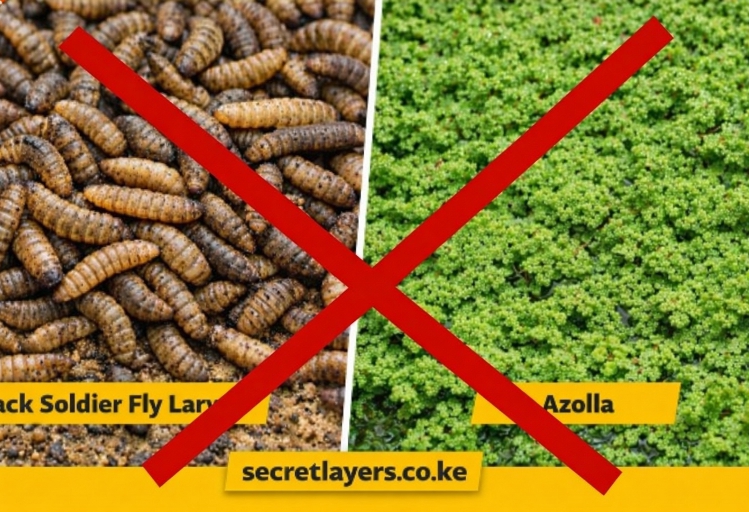
1. They Are For Small Farms
You have a 10,000 layer chicken farm. Alternatively, imagine running a 100-cow dairy farm.
Would you consider using black soldier fly larvae poultry feed for your chickens?
Or would you consider using azolla as cattle feed supplement?
Maybe you said yes. And honestly, I respect that.
However, I would not.
Think about the scale for a moment.
How many tonnes of BSFL would you need for the chickens? Likewise, how many tonnes of azolla would your cows require?
To make it worse, how many truckloads of garden or kitchen remains would you need to produce that amount?
The truth is simple. Most alternative poultry feeds work very well for small farms.
For example, if you have 500 chickens, azolla and BSFL can significantly reduce your poultry feed costs.
However, these options become almost useless for large-scale farmers like in the examples above.
A good example is Dr. Daniel Masaba, one of the most successful layer farmers in Uganda. He once tried using azolla and BSFL to reduce feed costs on his farm.
However, he later abandoned the idea.
In one of his videos, he explained that the system was not feasible for a large-scale poultry farm.
At that time, he had around 7,500 layers.
The reason is clear. The amount of production required to feed a large flock becomes massive.
Therefore, without serious infrastructure and capital, producing your own alternative poultry feeds can become more expensive than simply buying commercial poultry feed.
2. They Are Not Nutritionally Sufficient
Another problem is that alternative poultry feeds are not replacements for commercial poultry feed.
Instead, they act as supplements.
In other words, they are similar to the vitamins and minerals farmers add to feed. However, in this case, you must use larger quantities.
That is where the problem starts.
Yes, these feeds may reduce costs. However, by how much?
Certainly not 50%.
By the way, tell me in the comments: what percentage of feed costs do you think azolla or BSFL actually reduce?
Interestingly, many farmers cannot even say exactly how much money they are saving.
Meanwhile, if azolla, BSFL, and hydroponic fodder could completely replace commercial feed, I would be among the first people to use them.
Why?
Because feed prices are brutal right now. Every poultry farmer knows that feed costs are killing profits.
But the reality is different.
Even after preparing these alternative feeds, farmers still have to buy commercial poultry feed.
Therefore the farmer does extra work while still paying the same major cost.
For me, that is still a tough game.
3. You Cannot Measure The Nutrients
Layer chickens and broilers both require very specific nutrition at different stages of growth.
For example, growing layers need higher protein levels. Later, laying hens require higher calcium levels for strong eggshells.
Fortunately, commercial feed companies calculate these values very carefully.
As a result, each bag of poultry feed contains balanced levels of:
-Protein
-Energy
-Calcium
-Vitamins
-Minerals
Because of this system, guessing is removed and errors are very unlikely.
However, the same cannot be said for most alternative poultry feeds.
Standard nutrient estimates exist for azolla and BSFL. Unfortunately, those numbers may not match what you actually produce.
For example, how much protein is in your azolla pond today?
Even worse, how much protein is in your leftover cabbage or kitchen remains?
Honestly, you cannot know unless you send the sample to a laboratory.
As a result, birds may receive insufficient poultry nutrition.
Eventually, that problem begins to show in production.
You may start seeing:
-Fewer eggs
-Poor egg size
-Weak eggshells
Sadly, many farmers blame the feed company.
Meanwhile, the real cause might be the alternative poultry feeds being used.
4. They Are Hard To Produce Consistently
Personally, I like simple systems most of the time.
If you also like simple systems, I created a Free ebook for you.
It is a guide for starting and running a profitable layer poultry farm.
Gey your copy Now!
Now let’s compare the effort involved.
Compared to producing your own formulated poultry feed, raising azolla or BSFL may seem easier.
However, compare those systems to simply buying ready-made commercial poultry feed.
In that situation, I would still choose commercial feed.
The reason is consistency.
Producing alternative poultry feeds correctly requires several steps:
-Proper preparation
-Understanding the nutrient composition
-Formulating correct feed ratios
-Maintaining the system daily
In addition, farmers must do this every single day to keep results stable.
Therefore the system becomes harder than simply purchasing high-quality poultry feed.
However, if the benefits clearly outweigh the extra effort, then the work may be worth it.
Ultimately, that decision becomes a personal choice for each farmer.
5. Health Risks To Your Chicken
Imagine trying to reduce feed costs and accidentally killing your chickens.
That situation would be a farmer’s worst nightmare.
Fortunately, reported cases of problems from alternative poultry feeds are rare.
However, rare does not mean impossible.
Commercial poultry feeds are usually processed under controlled conditions. In addition, they often contain coccidiostats and quality controls.
Meanwhile, homemade feed systems can introduce new risks.
For example, kitchen remains might already be decomposing, food remains may contain spices or substances harmful to poultry.
Azolla can also become dangerous if it grows in dirty or contaminated water.
Poor storage can also lead to spoilage or fungal growth.
Meanwhile, black soldier fly larvae can transmit disease if they are reared or stored in unsanitary conditions.
Although such problems are uncommon, they are still possible.
Unfortunately, farmers may not even realize that the alternative poultry feed is the real cause of illness in their birds.
When Would I Use Azolla Or BSFL?
Those are the five reasons I would not use alternative poultry feeds on my farm.
However, there is one situation where I might use them.
That situation is simple.
I would consider them only if I planned to run a small farm.
However, that is not my plan.
In fact, the book I am currently writing contains a full chapter called “Before You Start Your Farm.”
One key idea in that chapter is this:
Think big. Build big.
That message is also central to the Secret Layers community.
Earlier, I published a post about five powerful solutions to high animal feed costs.
In that article, my first solution was simple:
Go big.
Large-scale farms benefit from economies of scale, better systems, and stronger profit margins.
Therefore my advice is clear.
Do not think small.
Do not stay small.
Most importantly, do not fall into the trap of farming trends that do not scale.
See you next Friday!
secretlayerske@gmail.com
carlosdeche4040@gmail.com