The Kenya National Bureau of Statistics (KNBS) released the 2026 Economic Survey. This is one of the most important documents about Kenya’s economy.
It covers every sector — from local farming to international trade, social trends, and emerging issues. Whether you are a local farmer or a foreign investor, this report has something for you.
In this post, I will give you a summary of Kenya’s agricultural sector from the KNBS 2026 report.
Specifically, I will focus on three areas:
– Production
-Employment
-Education
As a farmer in Kenya, this is one of those documents that shows you where agricultural trends are heading. So let us dive in.
1. Agricultural Production In Kenya 2025
First, let us look at the bigger picture. The Sub-Saharan Africa region saw its real GDP grow by 4.4 per cent in 2025, up from 4.1 per cent in 2024. This growth was driven largely by improved agricultural production and better commodity prices across the region.
Closer to home, Kenya’s real GDP grew by 4.6 per cent in 2025. The Agriculture, Forestry and Fishing sector — which contributes over 20 per cent of Kenya’s total economy — expanded by 3.1 per cent. In short, farming is still a major engine of Kenya’s growth.
Here is a crop-by-crop breakdown of what happened in 2025:
Maize production improved by 2.4 per cent to 45.8 million bags. This is good news for food security, since maize is Kenya’s staple crop.
Wheat production fell by 18.2 per cent in 2025, and imports also contracted by 3.4 per cent. As a result, total wheat supply dropped by 5.2 per cent — meaning bread and flour prices may remain under pressure.
Green leaf tea output dropped by 7.8 per cent. For smallholder tea farmers, this signals a difficult season that may have reduced earnings.
Coffee production, however, increased from 49,500 tonnes in 2023/2024 to 51,400 tonnes in 2024/2025. This makes coffee one of the bright spots for Kenyan export agriculture.
Sugar cane production dropped sharply by 24.7 per cent. This is a significant decline that puts pressure on local sugar supply and the livelihoods of cane farmers.
Pyrethrum production fell by 18.2 per cent, and pyrethrum extract dropped even further by 41.5 per cent. Consequently, farmers growing this crop saw a very tough year.
Rice paddy production increased by 6.4 per cent, supported by a 5.3 per cent expansion in irrigated land to 48,379 hectares. This shows that irrigation investment is paying off for rice farmers.
Fresh horticultural exports grew by 13.8 per cent in volume — a strong result. However, earnings from fresh vegetable exports fell by 9.0 per cent, largely due to Maximum Residual Level (MRL) violations and export interceptions.
MRL means the highest legally allowed amount of a chemical — usually a pesticide — that can remain in food after harvest. When Kenyan produce exceeds these limits, it gets rejected at the border.
Therefore, if you are growing vegetables for export, understanding MRL compliance is no longer optional — it directly affects your income.
Milk production increased by 3.5 per cent to 5.5 billion litres in 2025. Furthermore, marketed milk volumes grew by 11.5 per cent to 1.0 billion litres, meaning more farmers are successfully selling their milk rather than consuming it at home.
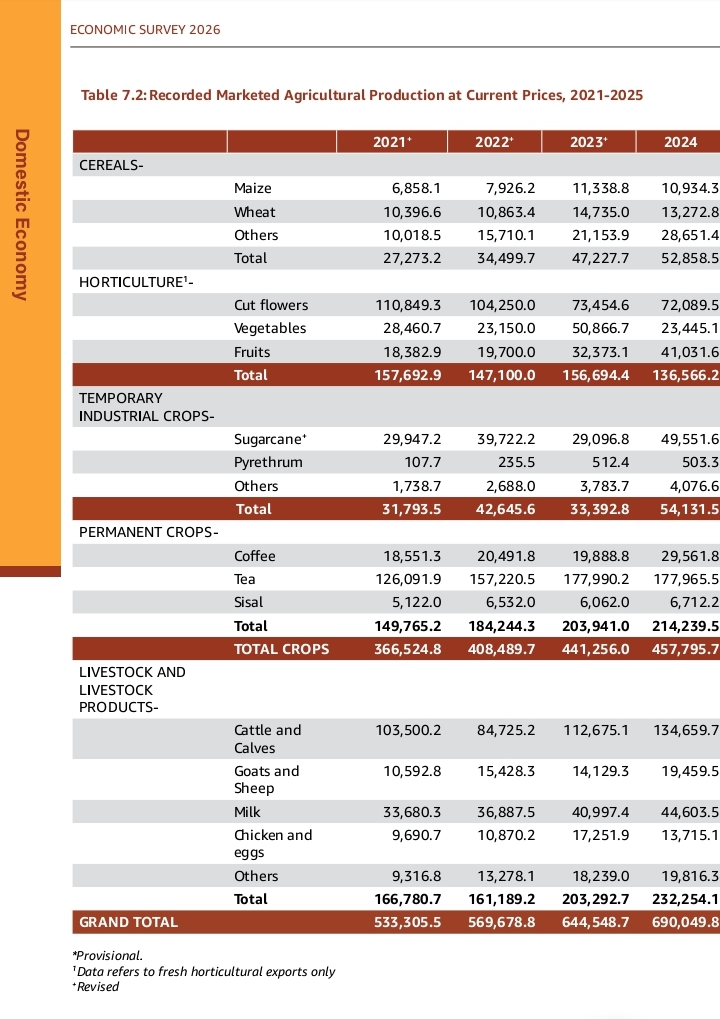
There’s probably a lot more than this.
2. Agricultural Employment In Kenya 2025
Now let us look at jobs. The agriculture, forestry and fishing sector remains Kenya’s largest employer overall. However, most of that employment is still informal and small-scale rather than salaried.
Formal wage employment in the sector stood at:
Private sector: 311,900 employees
Public sector: 42,700 employees (working in institutions like the Ministry of Agriculture, county agriculture departments, forestry agencies, fisheries departments, and agricultural research bodies)
Total formal jobs: 354,600
That said, the real story is in the informal sector.
Kenya’s informal sector employed 18.1 million people in 2025 — representing 83.8 per cent of total employment in the country. A large share of these are agriculture-related.
In other words, the smallholder farmer is not the exception. He or she is the majority.
These 18.1 million people are the backbone of Kenya’s food system. Yet most of them are farming without proper support, training, or resources.
That is exactly why I am building something for them — and I need your input to make it useful.
I’m On A Mission
I am on a mission to help the smallholder farmer make more money — from before they start their farm, all the way to when they harvest their results.
To do that well, I need to understand their challenges.
Help me fill in this short Before You Farm survey. It takes just 2 minutes.
In return, I will send you 2 of my Farming eBooks completely Free👇🏿


3. Agricultural Education Trends In Kenya (2021 – 2025)
Finally, let us look at the future — who is training to work in agriculture.
Student enrolment across agricultural institutions showed a significant increase between 2021 and 2025:
Degree level enrolments grew by 7.1 per cent, from 23,500 students in 2024 to 25,157 students in 2025.
Diploma level enrolments increased by 17.4 per cent to 2,089 students in 2025.
Animal Health and Industry Training Institutions (AHITIs) saw certificate enrolments rise by 55.2 per cent to 1,442 students.
Meat inspection certificates at Athi River Meat Training Institute recorded 196 new students.
Short-term vocational courses grew by 25.6 per cent to 922 students.
Overall, more young Kenyans are choosing agriculture as a career path. This is a very encouraging sign for the future of farming in Kenya.
Key Takeaways
-Agriculture is a key contributor to Kenya’s GDP, accounting for over 20 per cent of the economy.
-Agriculture is the largest employer in Kenya, with most people working in the informal sector.
-Enrolment in agricultural courses is rising across degrees, diplomas, and certificates — so the future of Kenyan farming is in good hands.
This is your overview of Kenya’s agricultural sector in 2025. It is a small glance, but I hope it has shown you the trends and the opportunities available to you as a farmer.
If you want to read the full KNBS 2026 Economic Survey, you can find it here:
https://www.knbs.or.ke/wp-content/uploads/2026/04/2026-Economic-Survey.pdf
What do you think about this report? And what is your outlook for Kenyan agriculture? Let me know in the comments.
Get your Free Ebooks if you haven’t.
See you next Friday!