Category: Reports

  • Why It Might Be Time To Quit Farming And Walk Away – Sunk Cost Fallacy

    What if I tell you maybe it’s time you actually killed that farm of yours.

    Yes. It might be time to sell everything.
    The birds. The animals. The houses. Maybe even walk away and start something new.

    I know. That sounds crazy coming from me.

    For the last 8 months I have been writing this blog, I have shown you my farming journey.
    I have shown you how farming can make you money. I have shown you how it can ultimately give you financial freedom.

    But today, let’s look at things from a different angle.

    Something Strange Was Happening

    Many years ago, economists noticed something odd.
    New businesses were losing money. A lot of money. More than they should.

    You might say — “Carlos, that’s normal. My small business hasn’t made a profit in six months.” And you’re right. Losses happen.

    But this was different.

    These businesses kept losing money for a long time. Way longer than made sense.


    That made the economists ask:
    Didn’t they see it happening?
    Couldn’t they spot the pattern?
    What were they waiting for?

    Then they noticed something else. Governments were doing the same thing. Losing money. Money that could have been saved if someone had acted sooner.

    That’s when the name Sunk Cost Fallacy was coined.

    The Sunk Cost Fallacy

    What Is The Sunk Cost Fallacy?
    It is simple.
    It is when you keep doing something because of what you have already put into it instead of looking at the outcome.
    Even when it is clearly not going to work.

    Time. Money. Effort.

    Here are some good examples..
    You keep watching a boring movie. Why? Because you already paid for it.

    You stay at a job you hate. Why? Because you have already been there 10 years — even though there is no promotion coming.


    You stay in a bad relationship. Why? Because you have already been together for 2 years.

    That is the sunk cost fallacy.

    The $9 Million Board Meeting

    Here is what it looks like in a real business.

    A company puts its best people, its money, and two years into a new product. The product flops. Almost no one buys it. The few who do won’t even tell their friends about it.

    So they have a board meeting..

    Person 1: We should kill this project. It is not working.


    Person 2: I agree. The market doesn’t want it.


    Person 3: But we have already put in so much time. (The beginning of the sunk cost fallacy)


    Person 4: Yes. And so much money. This is one of our biggest projects ever.


    Person 5: Think about all those 20-hour days we worked. Remember the commitment we made?

    They decide to keep going.
    At this point, they have lost $1 million.

    13 Months Later…

    Person 1: I think we should shut it down. It’s not going to work.


    Everyone else: Yeah. Kill it.

    Short meeting. But now they have lost $10 million.

    Why didn’t they stop at the first meeting?

    Sometimes Quitting Is The Right Move

    I believe in hard work. I believe in not giving up.

    But sometimes, quitting is the smartest thing you can do.

    A job. A career. A business. A project.
    Codie Sanchez, author of Main Street Millionaire, once said on her X page: “Quitters are winners.”

    Controversial? Yes. But think about it.

    Winners quit their bad habits. Their bad friends. Their bad environments. Their bad jobs. And then they go on to win with better ones.

    That is what she meant.

    Farmers Are Not An Exception

    Many farmers keep pouring money into a farm that makes zero profit. Whether it’s poultry, livestock or crops. It doesn’t matter.

    The scariest part? Most of them don’t even know they are losing money.

    If that is you right now — it might be time to put the hoe down and walk away.

    African man crying used to illustrate sunk cost fallacy.
    Maybe it’s time to quit that farming project and look for other viable opportunities.

    So How Do You Know When To Quit?

    Here are four things to ask yourself.


    1. Do you hate what you are doing?

    Pushing through something you hate helps no one. Not you. Not the people around you. Find something you actually like doing.


    2. Have you truly tried everything?

    Most people quit too early. They try 10 things and say “it didn’t work.” You need to try an unreasonable number of things first. Different methods. Different tactics. Different experts. Then, if nothing works — you have your answer.
    This is the most important one.


    3. Ask yourself: would I start this again today?

    Forget the past. Forget the money and time you already spent. If you were starting fresh today — would you choose this again?
    If the answer is no, that tells you something.


    4. Set your “kill criteria” before you start.

    Before you begin anything — a farm, a business, a project — decide in advance what will make you walk away. Write it down. When you hit that line, you walk. No guilt. No regrets.


    (This is one of the topics I’m considering to put in the farming bool I’m writing – Before You Farm. Tell me what you think in the comments)


    Quitting Doesn’t Make You A Quitter. It Makes You A Pivoter.

    Walking away from something that is not working does not make you weak.
    It makes you smart.

    For a deeper look at this topic, I recommend the book “Quit: The Power of Knowing When to Walk Away” by Annie Duke.


    What are your personal thoughts on quitting? Drop your thoughts in the comments.

    If you want to learn how to start and run a layer poultry farm profitably — grab the Free Ebook below👇🏿

    Name
    Limited access. Join other serious farmers who have taken the guide and get support.


    See you next Friday!

  • How Online MarketPlaces Can Save Farmers From Middlemen


    Let me tell you my story. I’m from Tezo, Kilifi County, about 10 km from Kilifi town. Sometimes, I buy one tomato for Ksh.10. On the best days, I’ve bought a single tomato for just Ksh.5.


    For someone who doesn’t know the supply chain for agricultural produce, that may seem normal. However, a deeper look—or just a quick search on Google—reveals the truth. It’s shocking and a little terrifying.


    In 2024, tomato prices in Kirinyaga dropped to Ksh.15 per kilogram. When a farmer sells that kilo for Ksh.15 to a middleman, the price in Kilifi jumps to around Ksh.70–100 per kilogram. That is a huge difference, and it shows how much profit is being captured by middlemen instead of the farmers who grew the tomatoes.


    Imagine if I could check online and see a farmer in Kirinyaga selling tomatoes for Ksh.40 per kilogram. I would buy immediately. I would pay Ksh.30–50 less. At the same time, the farmer would earn Ksh.25 more, which is a 167% increase. This kind of win-win situation is exactly what online marketplaces could make possible.


    It’s not as simple as it sounds. Many farmers in Kenya already use social media like WhatsApp, Facebook, Instagram, and TikTok to sell their produce. It works for some, but there are challenges that make it hard to scale and provide real value for both farmers and consumers.


    Today, let’s focus on farmers online marketplaces, like Mkulima Young, Mkulima Bora, and Mkulima Online. These are different from social media platforms.

    What Can They Do To Help Me Buy 2 kg Of Tomatoes From Kilifi At A Fair Price While Also Ensuring That Farmers Earn More?

    1. Logistics


    Farmers often cannot sell to all individual buyers across the country because transporting small amounts of produce is expensive. If they try to deliver on their own, the cost may wipe out their profits. Middlemen solve this problem by collecting from many farmers and delivering to consumers, but they usually pay farmers very low prices.


    Online marketplaces need a reliable logistics system to solve this problem. They can either build their own delivery network or partner with delivery companies. By solving this hurdle, marketplaces can help farmers sell at fair prices while making sure consumers still pay less than they would at the market.

    2. Trust


    Trust is one of the biggest challenges. No buyer wants to pay for goods that never arrive, and no farmer wants to deliver produce without being paid. Many online platforms in Kenya struggle because buyers and farmers are unsure whether the other party can be trusted.


    Even though M-Pesa exists for safe payments, many buyers prefer to negotiate on WhatsApp. People feel more control and security when they can see and communicate directly with the seller. Platforms like Jumia show that trust can be built over time with consistent service and marketing, but it takes years and a big budget to convince buyers to feel safe using a platform.

    3. Business Model


    Another important challenge is the business model itself. Should online marketplaces sell directly to consumers or focus on mama mbogas? A B2B (business-to-business) model could actually be more effective.


    In this approach, farmers sell at higher prices to the platform. The platform then sells to mama mbogas at lower prices than the middleman would charge. Finally, consumers get fresh produce at lower prices from the mama mbogas. This system ensures that everyone benefits: farmers earn more, mama mbogas pay less, and consumers get better prices.


    Twiga Foods uses a similar model. They buy produce directly from farmers at fair prices and supply mama mbogas reliably. Even though they act like a large middleman, they are more predictable and less exploitative. Online marketplaces could adopt this strategy to create a fairer agricultural supply chain.

    What Next?


    Farmers online marketplaces can succeed if they solve logistics, trust, and business model challenges. Platforms that address these issues will empower farmers, reduce middlemen exploitation, and make fresh produce more affordable for consumers. In the future, these marketplaces could even help farmers export produce across Africa and the world.


    Do you think online marketplaces can really help farmers escape middlemen?

    I’d love to hear your thoughts in the comments.

    Follow my YouTube channel to learn more about how you can start and run a profitable layer poultry farm👇🏿

    https://youtube.com/@secretlayerske?si=nYnAL-jwN6Wc3PlV

    See you next Friday!

    carlosdeche4040@gmail.com

    secretlayerske@gmail.com

  • NYOTA Fund : How I’d Use It To Build A Profitable Business

    If someone gave you Ksh.50,000 today, what would you do with it?

    This is how I would turn Ksh.50,000 (approximately $385) into a thriving business through the NYOTA Program Kenya.

    The government of Kenya, through the NYOTA Program, is offering grants and training to empower Kenyan youth. It’s an amazing opportunity for those who qualify. Unfortunately, I don’t meet the criteria for application, but if I did, here’s exactly how I would use the funds to build a sustainable business.

    Not something lifeless or short-term, but a venture with a real vision of growth.

    It’s sad that many businesses started through such government programs die off within a year. Evidence from the earlier Youth Enterprise Development Fund (YEDF) shows that only a small percentage survive past five years.

    That’s why I decided to share how I would personally use the NYOTA grant and the strategies I would apply to make the business last. I hope you’ll find value in it and maybe borrow a few ideas for your own plan.

    By the way, congratulations if you received the grant!

    Step 1 : Decide And Commit To One Business

    The first thing I would do is make a clear decision and commit to one business. I would choose layer poultry farming — and I have good reasons for it which you can check here👇🏿

    6 Reasons Why I Chose Layers Over Broilers

    It’s something I’ve been studying and researching for a long time, and that focus gives me an edge.

    There are many profitable opportunities out there. However, without clarity, it’s easy to end up confused and scattered.

    So I would decide, commit, and lock in.
    No broilers. No goats. No hotel. No forex.

    Layer poultry farming only.

    Step 2 : Learn

    Before starting, I would spend one to two weeks learning everything about layer poultry farming. That means not just how to raise the birds, but also how to run the business side of things.

    I’d study topics such as:

    ✅Brooding

    ✅Feeding

    ✅Disease management

    ✅Marketing and sales

    ✅Branding and negotiation


    In addition, I would visit established layer farmers and learn directly from their experiences. I’d talk to egg traders — both wholesalers and retailers — to understand the egg business better.

    I’d also reach out to poultry experts for practical advice.

    Meanwhile, I would get a reliable internet connection for a week and binge-watch YouTube videos about layer poultry farming in Kenya. I’d read blogs, success stories, and mistake lists.

    Of course, I would also check X, Facebook, and TikTok pages of farmers to see what works for them.

    Secret Layers is already a good place to start for this kind of information — both technical poultry farming and business.

    To help with this learning phase, I have a Free Layer Poultry Farming Guide you can get here 👇🏿

    Free Layer Poultry Farming Guide

    Another skill I would add is content creation. There are countless free online resources on how to make engaging and educational farming content.

    After one or two weeks, I wouldn’t be an expert yet, but I’d know enough to start my layer farm confidently.

    Step 3 : Start The Farm

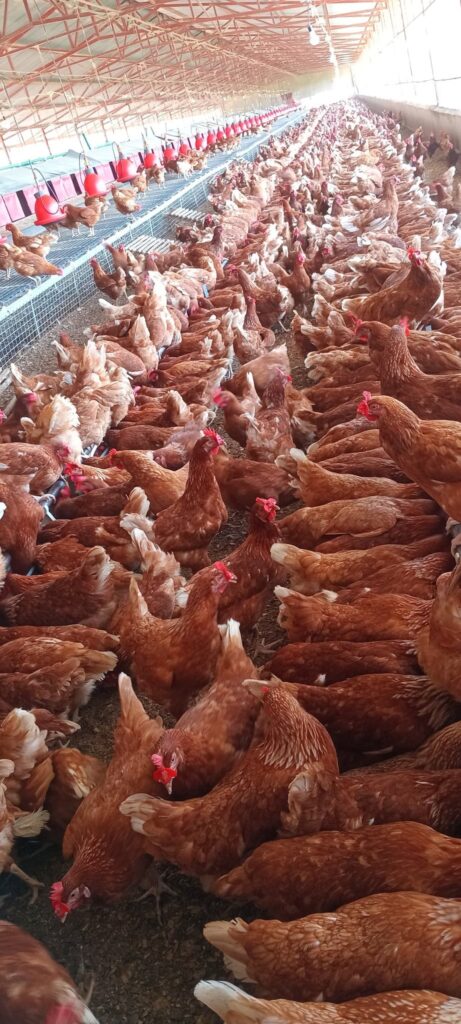
    Many layer chicken kept for eggs in a big poultry house.
    Layer Chicken in a poultry house. While Ksh.50k won’t get you this at first, with a long term business strategy you can get here.

    Next, I would begin the actual farm setup. My plan would be to start with 50 layer chickens. That’s enough to make sense as a business but still manageable for a beginner.

    However, there’s one issue. Starting a 50-bird layer poultry farm in Kenya costs around Ksh.91,000, according to my recent research (see the cost breakdown here👇🏿

    The True Cost Of Starting A Layer Poultry Farm


    Yet, the NYOTA Program grant is only Ksh.50,000.

    So how would I bridge that gap?

    I have a plan — and I’ll share how to make it work. Just trust me and follow the logic to the end.

    I would follow the exact process outlined in my Free guide to set up the farm and get my chicks started.

    At this point, the farm would be running.

    Now, layer chickens take about four and a half months before they begin laying eggs. That means no cash flow for about five months.

    So what next?

    Step 4 : Create Content Around My Farming Journey

    During this waiting period, I would focus on creating content. I’d document my entire journey from day one — every success, failure, and lesson learned.

    Don’t frown yet. Maybe if I say “teach people what I’m learning,” it will sound better. But yes, I’d share my journey publicly.

    This would include content across YouTube, TikTok, Facebook, X, and Pinterest. However, I’d focus mainly on the three I use most — Facebook, X, and YouTube.

    This approach is exactly how Secret Layers started — by teaching and documenting.

    For instance you can watch the YouTube video of this blog post here👇🏿

    https://youtu.be/0B_B0QsqW50?si=7NCNMw7cNJ7jBiQc

    Setting up social media accounts is free. The only small cost would be basic content tools like a ring light, tripod stand, and microphone — not more than Ksh.3,000 ($23).

    There are two main reasons for creating content:

    1. To build a brand around my farm.
    The content would serve as my marketing and branding engine.


    2. To create a potential income stream.
    In time, monetizing these platforms could bring in more money to grow the farm further.


    At that point, I’d have two things running – a real farm and a growing online brand.

    That’s the foundation of a long-term business.

    Now The Secret To Make My Whole Plan To Work

    Step 5 : Partner With Another Beneficiary

    Now, remember that the cost of starting the 50-bird farm is Ksh.91,000, but the grant is only Ksh.50,000.

    Here’s the secret to make it work.

    I would partner with another NYOTA Program beneficiary. Together, we would combine our grants for a total of Ksh.100,000.

    The NYOTA Program includes a training period before the funding phase. I’d use that time to identify a serious, like-minded partner — preferably someone from my area, maybe a friend, or someone who shares my farming vision.

    Finding the right partner isn’t always easy, but it’s the smartest way to make this plan possible. And I would treat it like my life depended on it.


    That’s my blueprint for how I would use the NYOTA Program grant to build a sustainable and profitable business.

    You don’t need millions to start. With focus, learning, and creativity, you can turn Ksh.50,000 into something that grows year after year.

    If you’ve received the NYOTA grant, congratulations again. Use it wisely, and build something that will last beyond five years.


    💡 If you want to start your own layer poultry business..


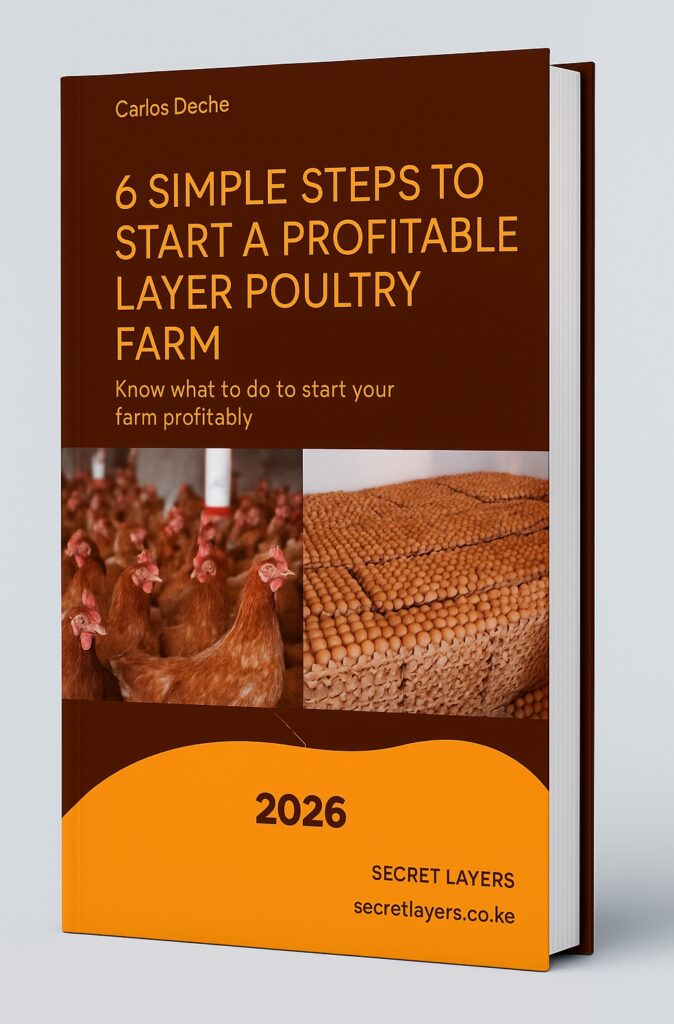
    Get my Free Guide: 6 Steps to Start a Profitable Layers Poultry Farm here👇🏿

    Free beginners guide to starting a profitable layer poultry farm. Step by step guide.
    Name
    Limited access. Join other serious farmers who have taken the guide and get support.


    And I’d love to hear your thoughts — what would you do with your Ksh.50,000 NYOTA grant?

    Let me know in the comments.

    See you next Friday!

    carlosdeche4040@gmail.com

    secretlayerske@gmail.com

  • Why Animal Feeds Prices Are High In Kenya -(CAK Report 2024)

    “Feeds will kill your business.”
    You’ve probably heard this statement over a million times.
    It’s what many are told when they decide to get into poultry farming — that you’d make a lot of money, were it not for the prices of feeds.
    Worse still, feed prices keep rising year after year.

    From 2020 to mid-2022, poultry feed costs in Kenya rose by 40–50%.
    Following the same trend, feed costs in Kenya 2025 could increase by another 25%.
    Is this a lie? Definitely not.

    Animal feeds are the single largest expense on any poultry farm — layers or broilers.
    Even for livestock like cattle, pigs, or fish, feed accounts for about 70% of the farm’s total expenses.
    After deducting labor, vaccines, water, and other costs, most farmers are left with around 20% of their revenue as net profit.
    Some don’t even break even.
    Worse still, some incur losses.

    To survive, farmers try different ways to reduce feed expenses:

    -Buying cheaper, low-quality feeds. This often backfires due to poor egg production and even greater losses.

    -Purchasing in bulk for discounts. Only large farms benefit from this.

    -Supplementing with local feed options such as pawpaw, vegetables, azolla, or hydroponic fodder. These are difficult to balance nutritionally.

    -Producing their own feed. While this is cost-effective, it only works for large farms that understand feed formulation and raw material sourcing.

    So What Did I Do?

    As part of my research on why animal feeds prices are high in Kenya — a concern that keeps many from starting poultry farms — I came across a 2024 Animal Feeds Inquiry Report by the Competition Authority of Kenya (CAK).

    This report explored the reasons behind the high feed prices and made key recommendations to solve the issue.

    Below is a summary of the report.

    In my next post, I’ll share my personal take on how the government and farmers like us can take action.

    If this problem is fixed, Kenya could unlock massive employment opportunities across the animal feeds value chain.

    Manufacturers, distributors, farm owners, and workers would all benefit.

    Increased egg production would follow — the cheapest source of protein for most African families — and this would help reduce malnutrition across the continent.

    But Is This Problem Unique To Kenya?


    Unfortunately, yes.
    Among East African countries, animal feeds prices in Kenya are the highest.
    Compared to international benchmarks, feed prices here remain unreasonably high.

    Kenya also struggles with the influx of cheaper imported eggs, mainly from Uganda.
    Why? Because Uganda has lower poultry feed costs, allowing their farmers to sell eggs more cheaply while still making a profit.
    This puts Kenyan poultry farmers at a serious disadvantage.

    So Why Are Animal Feeds Prices High In Kenya?

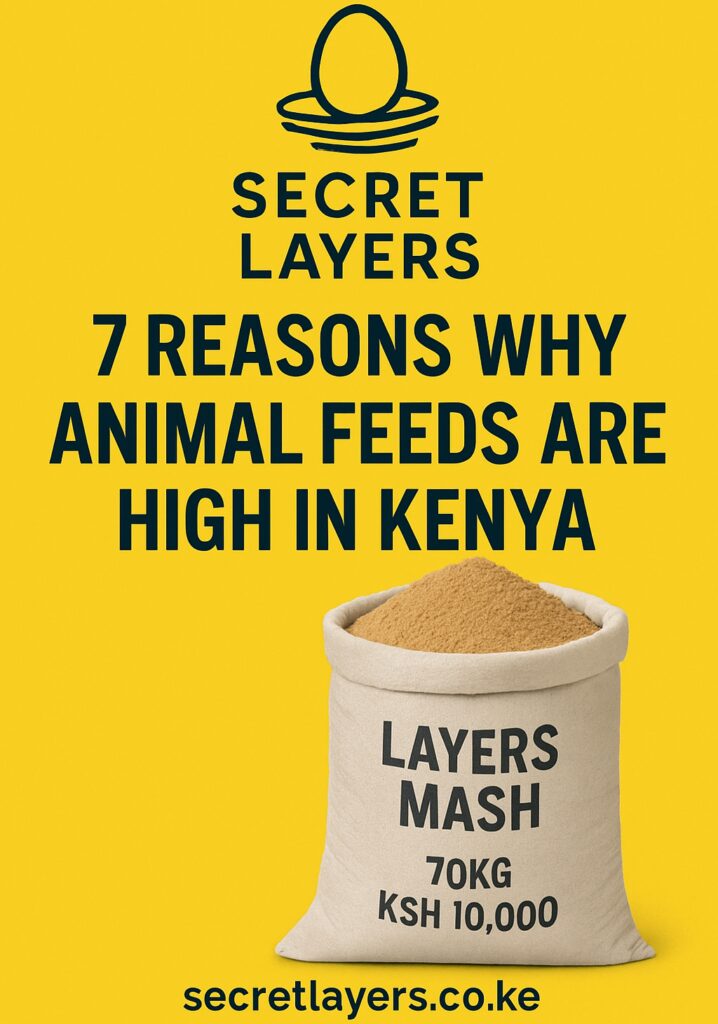
    A 70kg bag of layer mash going for Ksh.10,000 showing the extent of high animal feeds in Kenya.Secret layers summary of the CAK Inquiry Report,2024.
    7 Reasons why animal feeds are high in Kenya according to Competition Authority of Kenya(CAK) Inquiry Report,2024.

    According to the CAK report, there are 7 key reasons behind the high animal feed prices in Kenya:

    1. Heavy Dependence On Imported Raw Materials

    Kenya doesn’t produce many of the raw materials needed to make poultry feeds.
    Instead, we import them — and this adds costs at every step.

    Soybean meal is imported mainly from Zambia, Malawi, and Uganda.

    Sunflower cake comes from Tanzania.

    Vitamins and additives are brought in from countries like China, the Netherlands, and Germany.

    Every stage of importation — from foreign exchange, transport, taxes, and port delays — raises the final price.
    Local farmers pay for all this when they buy feeds.

    This overreliance on imports makes our feed prices volatile and sensitive to global changes.

    2. Market Dominance By A Few Feed Manufacturers

    Only four companies control over 50% of the commercial animal feed market in Kenya.This means just a few players determine the pricing trends.

    While the report does not accuse them directly of collusion, the structure allows for potential price control.
    This limits the power of smaller players and gives big companies room to increase prices unchecked.

    When competition is low, innovation and price cuts disappear — bad news for smallholder farmers.

    3. Unfair Pricing For Non-Integrated Feed Producers

    Some feed companies are “integrated,” meaning they also own or control the supply of raw materials.
    Others rely on external suppliers for inputs.

    In 2021 and 2022, the report shows that non-integrated feed producers were charged higher prices for inputs.
    This “margin squeeze” forced many smaller producers out of business.

    So the fewer the producers, the less competition — and the higher the feed prices.

    If you’ve ever wondered why the small local feed company died, this is a major reason.

    4. Input Processors Set Their Own Rules

    Most natural processors of feed inputs like oil cakes and grains are based in East and Southern Africa.
    Because they dominate the region, they can dictate trade terms and pricing.

    Kenya, being a buyer, has little say.
    Our feed manufacturers must accept the high prices or go without.
    This makes it harder to produce affordable poultry feed options for local farmers.

    5. Lack Of Transparency And Information Sharing

    Large feed suppliers in Kenya often exchange information with each other.
    However, smaller players are left in the dark.


    This lack of transparency allows the big players to coordinate pricing — even without formal agreements.
    It also blocks new entrants from competing fairly.

    When small businesses don’t know the actual market rates or raw material trends, they can’t plan or scale.

    This keeps animal feeds prices in Kenya unnecessarily high.

    6. County Taxes Create Fragmented Markets

    One of the most frustrating problems for manufacturers is the inconsistent and excessive county taxes.
    These vary wildly across Kenya and make the distribution of feeds expensive and unpredictable.

    For example:

    Machakos County charges Ksh. 20,000 annually per vehicle for distribution.

    A separate Ksh. 20,000 is charged for branding.

    Each truck needs a Ksh. 2,500 annual transport sticker.

    On top of that, there’s a daily parking fee of Ksh. 500 per truck.

    Other counties add more charges:

    In Kericho, feeding all six sub-counties could cost at least Ksh. 1,200 per day per truck.


    In Tharaka Nithi, manufacturers must pay all vehicle parking fees upfront — regardless of how often they deliver.

    And it doesn’t stop there.
    Counties also charge Agricultural Produce levies for inputs like rice polish, salt, and maize bran.
    These additional costs are passed on to the farmer.

    All this leads to one thing: higher feed costs across Kenya.

    7. Limited Use Of Yellow Maize For Feed

    In countries like Uganda, both white and yellow maize are grown.
    White maize is used for human food, while yellow maize is reserved for animal feed.

    But in Kenya, almost all maize is white — and it’s used for both food and feed.
    This creates direct competition between humans and animals.

    In 2025, maize prices rose and this means layer feed prices will ‘jump’ by almost 30%.
    Why? Because the demand for maize in feed production still outpaces supply.

    If Kenya increased yellow maize production, feed manufacturers could have a cheaper, dedicated source.

    Why Poultry Feed Rises Faster Than Dairy Feed

    Dairy feed is easy to make — just mix the ingredients.
    No need for expensive machines.

    Poultry feed, on the other hand, requires pelleting and crumbling, which needs precise formulation and investment in machines.
    This increases production costs and drives up prices.

    It’s no surprise that poultry feed costs in Kenya continue to rise faster than other animal feeds.

    What CAK Recommends

    To solve the problem, CAK made several important recommendations:

    1. Reposition the animal feeds industry.
    Invest in the sector and remove existing barriers to unleash its job creation and production potential.


    2.Improve cross-border markets and regulations.This would make it easier to source inputs at fair prices across COMESA and EAC regions.


    3. Eliminate county-level trade barriers.
    Unpredictable taxes hurt feed manufacturers and distort national pricing. These must be reviewed and harmonized.


    4. Track and monitor feed markets.
    Government and regional bodies should assess whether Kenya’s feed prices match international trends.
    They should intervene in cases of anti-competitive behavior.


    5. Add animal feeds to KAMIS monitoring system.
    This would help create transparency in feed pricing, benefiting both manufacturers and farmers.

    What This Means For You

    If these solutions are fully implemented, poultry farming could become more profitable.
    Lower and stable feed prices mean more profit, less stress, and better planning.

    Imagine earning 40% more because feed costs dropped.
    It’s not a dream — it’s possible with the right reforms.

    In My Next Post…


    Next Friday, I’ll share what I believe we farmers and the government can do to lower feed prices sustainably.
    These are practical, long-term solutions that will build on CAK’s findings.

    Together, we can take agriculture to the next level — maybe even Mars 🚀

    📄 Read the Full CAK Inquiry Report here

    Before You Go

    💬 Which CAK recommendation do you think would help the most?
    Leave a comment below.

    📩 Want more updates like this?Enter your details below to grab a copy of my free guide and regular Layer Chicken Digest tips and reports via email:

    Free beginners guide to starting a profitable layer poultry farm. Step by step guide.
    Name
    Limited access. Join other serious farmers who have taken the guide and get support.

    See you next Friday!

    Carlos Deche

    secretlayerske@gmail.com

    carlosdeche4040@gmail.com